
I read the book Triggers (Triggers), written by Joseph Sugarman, and I have also attended his seminar.
Marketing expert Aleš Lisac wrote about Sugarman that he is a genius of marketing and sales, and I can certainly confirm this myself.
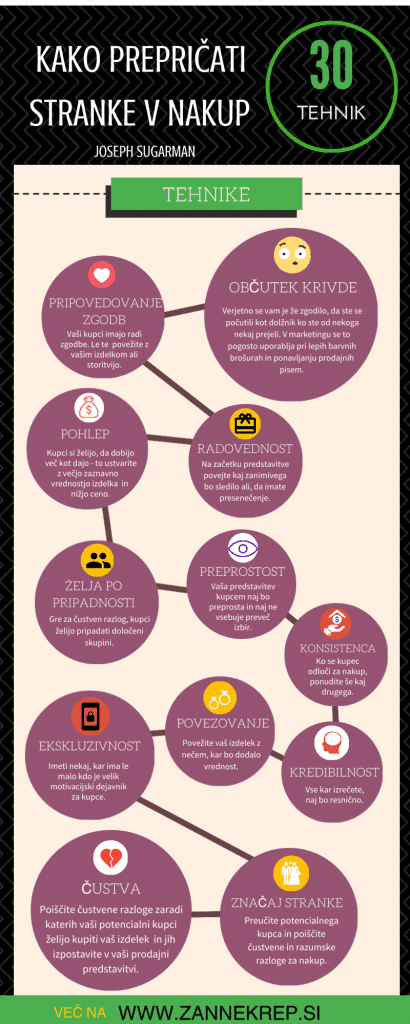
The techniques Sugarman talks about are:
- Storytelling (storytelling)
Your customers love stories. Use stories in your presentations and connect them to your product or service. - Guilt (guilt)
You have probably experienced feeling like a debtor when you received something from someone. In marketing, this is often used with attractive color brochures and repeated sales letters. Think about what kind of attention you will give your customers to evoke this sense of guilt or need for reciprocity. - Curiosity (curiosity)
At the beginning of your presentation, mention something interesting that will follow, or that you have a surprise in store. - Objection raising (objection raising)
Highlight the shortcomings of your product or service right at the beginning of your presentation. - Objection resolution (objection resolution)
Refute the objections you raised and thereby increase the chances that the customer will buy from you. A very good sentence to start with is, for example: “You expect us to tell you how good our product is, but unfortunately…” and then you begin your story. - Desire to belong (desire to belong)
This is an emotional reason, as customers also buy because they want to belong to a certain group (for example, Mercedes owners). - Greed (greed)
Customers want to get more than they give — create this with a higher perceived value of the product and a lower price. - Satisfaction conviction (satisfaction conviction)
Give the customer a trial period during which they can return your product or service. - Simplicity (simplicity)
Keep your customer presentations simple and avoid offering too many choices. - Consistency (consistency)
Once a customer decides to buy from you, offer them something else as well. - Authority (authority)
Customers want to buy a product from a person or company that is considered a recognized expert in the field. - Involvement and ownership (involment and ownership)
Talk to your potential customer as if they have already purchased the product and are already trying it out. - Sense of urgency (sense of urgency)
If a customer does not buy immediately, there is a chance they will change their mind later, so give the customer a reason to buy right away. - Harmonize (harmonize)
Your presentation to the customer should always be in harmony with your customer and their needs, meaning the customer agrees with your claims, while you remove anything that could provoke disagreement. - Credibility (credibility)
Everything you say should be true. - Desire to collect (desire to collect)
There is a need for collecting among customers — take this into account. - Exclusivity (exclusivity)
Having something that very few others have is a major motivational factor for customers. Also consider making your product or service limited in time. - Linking (linking)
Connect your product or service with something else that adds value to it. - Mental engagement (mental egagement)
Mentally involve customers in your sales process, for example through guessing. - Patterning (patterning)
Find the most successful competitors in your industry and mirror their approach. This does not mean copying them, but adding something of your own that is unique. - Product character
Identify which product features convince the customer to make a purchase and shape your presentation accordingly. - Customer character
Study your potential customer and find the emotional and rational reasons for purchasing your product, then highlight them in your presentation. - Proof of value (proof of value)
Include comparisons with other products or services, savings, and similar elements in your sales presentations. - Familiarity (familiarity)
If a customer is familiar with your product or service, they are more likely to make a purchase. - Specificity (specifity)
Specific data is more credible (for example, 69 percent). - Emotion (emotion)
Remember that emotions sell. Find the emotional reasons why your potential customers want to buy your product or service and highlight them in your sales presentation. - Justify with logic (justify with logic)
When making a purchase, also give the customer a rational explanation that justifies the purchase, in addition to emotional reasons, such as savings. - Hope (hope)
Consider whether your product or service inspires hope and highlight that. - Integrity (integrity)
This refers to the consistency of actions with words. - Honesty (honesty)
Always tell the truth, as false statements can easily destroy a sale.