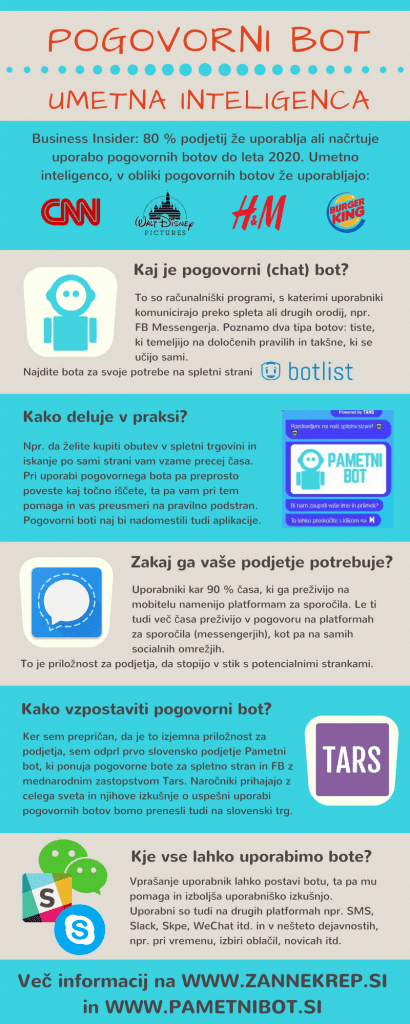

According to a report by Business Insider, as many as 80 percent of companies are already using or planning to use chatbots by 2020.
Artificial intelligence has arrived in the form of chatbots, already being used by established companies such as Disney, H&M, Ebay, CNN and Burger King, and their use has also been publicly praised by celebrities such as Katy Perry. In Slovenia, very few companies are currently using chatbots, but this will change within a few years. Bots have received a great deal of praise in many internationally recognized media outlets, for example they have been covered by Forbes, CNBC and Venture Beat.
What is a chatbot and how is it used?
Chatbots are computer programs that allow users to communicate via the web or other tools, such as Facebook Messenger. There are two types of bots: those based on specific rules, and more advanced ones that learn on their own. If you would like to find a bot for your needs, I suggest you visit the website BotList.
A concrete real-world example of a useful chatbot is when you want to buy footwear from an online store — you would normally have to go to their website and find the desired footwear, which could take quite some time. If you used a chatbot for the same search, you could tell it exactly what you are looking for with just a few questions, and the chatbot would tell you precisely, or even redirect you directly to the specific product page you are looking for, or help you in some other way. Chatbots are also expected to replace apps, as users don’t need to click buttons on a website or app — instead, the user can simply ask the bot a question, which then helps them and improves the user experience. Bots are also useful on other platforms such as SMS, Slack, Skype, WeChat etc. They are useful in countless industries, for example for weather, choosing clothing, specific news you are looking for such as entrepreneurship, answers to frequently asked questions, or for learning. With bots, companies can eliminate the biggest problem with websites — that users come to the site and leave without the company ever knowing who they were. Tens of thousands of developers around the world have already joined in the further development of chatbots.
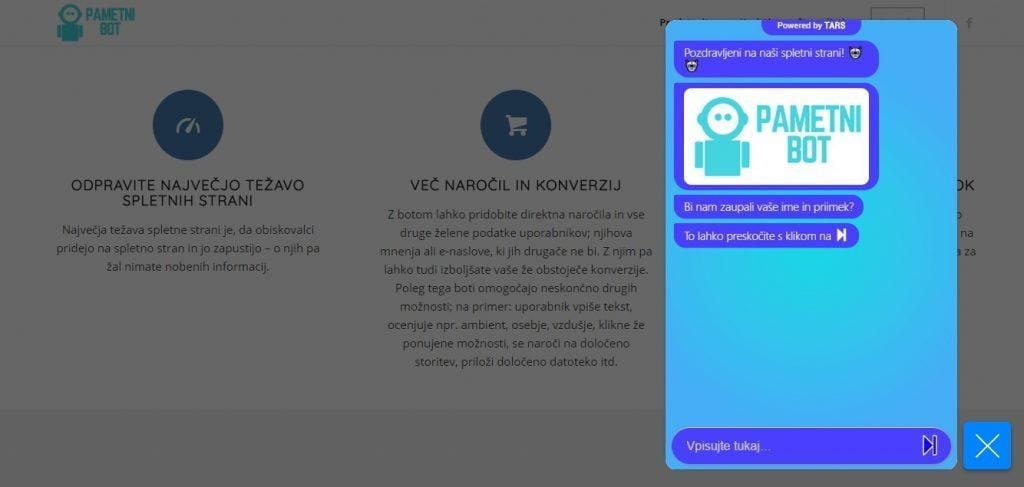
An example of how Pametni bot works at www.PametniBot.si:
Examples of bots in practice:
Useful resources for bots:
Why would your company need a chatbot?
When Facebook announced the arrival of a smart bot on its messaging platform (Messenger), the world was flooded with debate about the use of chatbots. Users spend as much as 90 percent of their time on mobile devices on messaging platforms or email. It is also very interesting that users spend more time in conversations on messaging platforms (messengers) than on social networks themselves, and this is a great opportunity for companies to get in touch with their potential customers. It is always important for companies to communicate with customers where their customers actually are.
Who can help you or set up a chatbot for you in Slovenia?
Due to the exceptional opportunity for companies, and because I started using bots myself, I decided to help Slovenian companies with the setup and use of chatbots, so I opened the first Slovenian company called Pametni bot, which offers chatbots for websites and Facebook with international representation from Tars from Bangalore, India. Tars customers come from all over the world and their experiences with the successful use of chatbots can be transferred to the Slovenian market as well. You can also view the Tars case studies.
If you would like to build a bot yourself (which, at least in the case of a web bot, can take a lot of your time) I suggest the following platforms for building bots, which are more suited for creating Facebook bots:
- Chatfuel
- Meokay
- Facebook bot for Messenger
- Telegram Bots
- Microsoft Bot Framework
- Botkit
- ChatScript
- Botsify
- Beep Boop
- Flow XO
- Chatty people
- rebot.me
- Octane AI
- Gupshup