
I have read for you the book Your First Customers, written by Jack Kaufman and Adii Pienaar. Every business needs customers at the beginning and beyond, because without customers a business simply dies.
Focus on solutions for customers
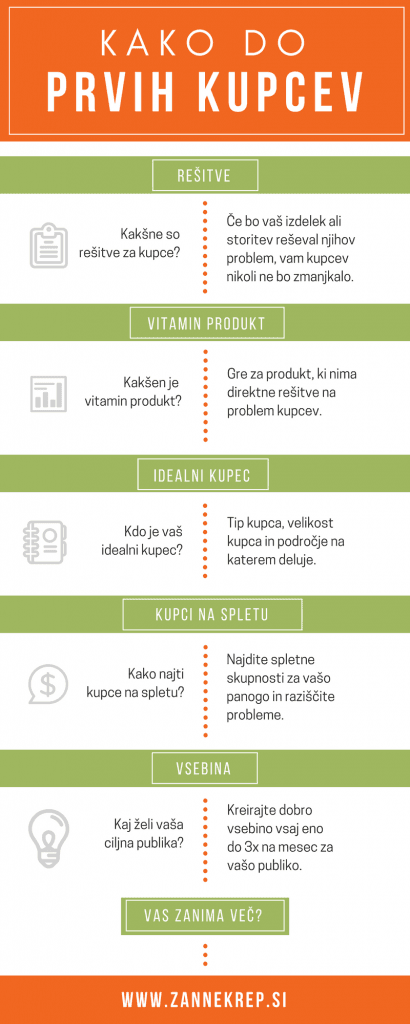
If your product or service solves a customer’s problem, you will never run out of customers. Brennan Dunn says that a company must focus on guiding your customers from the problem they have to the solution.
Example: The problem is rain, the product is an umbrella, and the solution is that you are protected from the rain.
Create a so-called “vitamin product”
This is a product that does not directly solve a customer’s problem, but the customer still gains value from it — for example, you help them expand their business into new markets, increase their number of Facebook followers, etc.
Steps to arrive at a “vitamin product”:
– choose a market where you would like to create such a product
– research what is important to customers in that market, e.g. business growth, increasing profit, reducing costs, more repeat customers, etc.
– find a way to help with what your customers are looking for
A good example of such a vitamin product is the program Ambassador, which helps convert your customers into ambassadors for your brand, and these customers help you acquire new customers in this way. Many businesses don’t necessarily need referral marketing, but it can still be a way to help companies increase revenue and gain new customers.
Think about your ideal customer
But thinking alone is not enough — you also need to go out to customers and ask them what they think about your product, and prepare your marketing in a way that attracts customers to use your product.
Steps for determining who your first customers are:
– type of customer (B2B, B2C, freelancers, etc.)
– size of customer (more than 10 employees, beginners, etc.)
– the field in which the customer operates, e.g. designers, managers, etc.
Use what is already popular
Build a product on top of what is already popular or currently in a growth phase — for example, build an analytics tool for Paypal, or create an informational product about how to use an existing program.
Find your customers online
If your customer is, for example, a project manager, use LinkedIn to find them. The author advises that you ask them for a call in which you ask about the problems they face, so that you can further improve your product. Also find online communities for your industry and explore the questions and problems customers encounter — for example, Dribbble, if your customers are designers.
Check out the following communities and try to participate in discussions:
– Hacker News
– Designer News
– Growth Hackers
– Inbound
– Product Hunt
– Dribbble
– Reddit
– Quora
– Twitter (use the Twitter search)
– LinkedIn (use the search for posts and comments)
A practical example:
There was a question on Quora about an alternative to the landing page LaunchRock, where Scott Watermasysk wrote an answer about their service KickoffLabs, through which he gained quite a few customers.
Also speak with your customers in person
If, for example, your potential customer is a restaurant owner, ask them if they would speak with you for free (or charge you for their time, e.g. half an hour). In the conversation, focus on the problems your customers have. Patrick McKenzie used this strategy for Appointment Reminder, where he spoke with 15 potential customers in person in exchange for payment (though most did it for free).
An example email, or how to approach customers by email (once you find their contacts):
Hello Miha,
My name is Žan. I am an entrepreneur who has started a new project and would like to develop a product that enables XXX (the main benefit of your product) for people who XXX. I have done some research and found that you work in XXX. Would you be interested in answering a few questions about XXX? These questions would be very helpful for my further work and will take 20 minutes of your time.
Two key questions for customers:
– what problems they face and which is their biggest problem
– what solutions they already use to solve their problems
How to get money from customers:
Keep in mind that if a customer receives great added value from your product, they will be happy to pay for it. It is very important to tell customers how much the product will cost and to actually ask if they will buy it. The authors recommend finding at least 5 customers who are willing to pay for the product before it actually exists (consider a special pre-order price and offer them a money-back guarantee).
What if you find out your idea is not good?
There is nothing wrong with stopping development if you find out, for example, that your idea does not solve a problem or that customers are not willing to pay for your product. If your idea does not solve customers’ problems, you will have a hard time finding them. The worst thing is to continue with an idea even after you have found out it will not work.
Become a teacher
Nathan Barry, the author of the successful book Authority, says that it is important to teach others about things that matter to them, and that this is the easiest way to build an audience and establish contact with future customers. It is very important to teach about topics that interest your specific target audience.
Always have a call to action
– ask people to give you their email – the primary goal, as this is the most profitable in the long run
– have your visitors share on social networks, which should never be the primary goal (since your posts there are not as visible and personal as with email)
Don’t let your target audience die
Create good content at least one to three times per month and distribute it 1 to 2 times per week to your audience. You need to make sure the content is truly good and therefore expect nothing in return. 95 percent of your communication with your audience should be giving them something for free, and 5 percent for things like selling your product or service.
How to properly sell your product to your email list
Give them advice on how to solve their problem even if they don’t buy your product, and conduct an interview with your ideal customer where the focus should be on tips and strategies.
Build a Minimum Viable Audience
This is an idea by Brian Clark from CopyBlogger about building your target group. Aim for a minimum of 1,000 people on your email list who will, for example, comment on your blog posts and also respond when you ask a question by email.
Influencer marketing
This type of marketing is about building good relationships with people that your target audience follows and trusts. Keep in mind 80 to 100 people with whom you would build a good relationship. Alex Turnbull from the Groove blog reached $100,000 in monthly revenue and a thousand new email subscribers every day by creating a series of articles specifically for influencers in a particular field about how he achieved the growth of his startup. Alex did not contact influencers directly; instead, he first followed them on Twitter and wrote them at least two tweets every week, left comments on their blog posts, and shared their content. A good tactic for building a relationship with influencers is to conduct a short interview with them, for example two to three questions, making it easier to later ask them for a share.
How to find the email of any person
One of the best ways to start communicating with people is to send them an email. You can use several different tools, e.g. hunter, Toofr, Rapportive and Mail tester. With these tools, try using a first name, last name, or at least a first name to find the correct email you are looking for.
Free tools for your customers
If you create a free tool that benefits customers, people will recommend and share it further. If you don’t know how to create a free tool, you can sponsor existing tools. An example is Runscope, which has 6 free tools: RequestBin, Embeded curl, hurl.it, API Changelog, API digest and API jobs.
Integration marketing
This is about integrating your product with an existing product that your customers already use or want to use. By connecting with a good product you can gain a lot, as they will then also promote you. An example of good integration with others is Zapier, which can connect with 250 applications.
Ask bloggers if they can write a review of your product
This will make it easier to reach customers, as they will expose you to their readers. It also helps with your optimization (SEO). Focus initially on smaller blogs rather than large publications, as it is easier to get them to write about you. Offer bloggers, for example, one year of your product for free, a certain percentage of sales, or a discount for their readers.
Example of how to write an email to bloggers to write a review of your product:
Hello x,
My name is x and I am currently preparing a product that helps xx. This is how I started with the product (your story, which should attract them in a few sentences). I am wondering whether you would be interested in writing a review of product x for your blog x. I believe your readers will find the product interesting (give a good reason). If you write a review, I will give you x for free.
Product improvements
Send emails to customers who pay you – for example, write to them three times a year and ask them about changes, improvements, and new features they would like to see in your product. It is important to take into account the suggestions of those who are your customers and not those who don’t pay you and will probably never be your real customers. Decide for yourself which suggestions you will actually adopt so that they reach the widest possible circle of your customers.
Your product doesn’t need to be perfect from the start
Remember that it is better to start with a somewhat imperfect product and improve it later – rather than developing the product for too long and then discovering in practice that customers don’t need much of it. It is best to add certain additional features to the product later, as this will also make it easier to build trust with existing customers who will see improvements after their purchase.
Good support for your customers
Is key to maintaining the trust of existing customers. It is also very important that customers can easily get in contact with you. Customers should receive a response within 24 hours. Also have answers to frequently asked questions (FAQ). Remember, if you provide customers with good support, they will recommend you to others.
Don’t be afraid to share your monthly financial results
Most people don’t dare to show their financial data, but your customers are interested in it too. Good examples are Pat Flynn and John Lee Dumas, who monthly publish exactly where their monthly revenues come from and all the expenses for their business, and also explain when there are fluctuations why, in their view, these fluctuations occur.
Use SEO (search engine optimization)
The authors of the book recommend reading the following resources on optimization:
– Moz beginner’s guide (beginners guide)
– Neil Patel advanced guide (the advanced guide to seo)
– SEObook.com
– Paddy Moogan’s book on link strategy (the link building book)
Also consider the strategy of using an exact-match domain, such as a search term with high monthly search volume – an example of this is the website Bingo Card Creator or Appointment Reminder. For a domain that contains the exact search term in its name, use only .com, .net or .org domain extensions, as you will more easily appear in search results.
Charge people even if your product is in “beta phase”
A good example of this is Zapier, which acquired approximately 800 beta customers during its beta phase. The best approach is to charge customers a kind of entry fee for the beta phase and later notify them of the monthly subscription, possibly offering an additional discount for an annual or two-year subscription if they choose to go that route.
Sell the idea to early buyers (pre-order customers), even if you don’t have a product yet
Clay Collins raised $40,000 in annual subscriptions for Leadpages this way. The formula Clay used was to have people participate in building the product, ask them about their problems, and tell them that your product will solve exactly their issues. Offer your early buyers additional features and special discounts, for example for a later annual or two-year subscription. Limit the time and number of early buyers before you launch the actual product. Gather endorsements from people your customers trust (an authority figure, a well-known person) and do something special for them, such as an additional webinar, send them a special t-shirt, etc.
Use your customers’ language
The authors advise that you record and carefully listen to your customers, and use their language for all your sales materials. Consider which words they use most frequently, what their biggest problems are, etc.
A/B test your sales materials
Expert Patrick McKenzie recommends starting to A/B test once your website has at least 3,000 visitors. You can test your website headline, calls to action, photos, etc. Tools that can help you here are Optimizely or Visual Website Optimizer.
If you want to learn more about A/B testing, you can read about it at:
- Patrick’s McKenzie blog
- Optimizely blog
- Visual Website Optimizer blog
- Visual Website Optimizer complete guide (complete guide)
Cold emailing
This is a strategy where you introduce your product to unknown potential customers. This strategy is good for the initial phase, for example to reach up to a thousand customers, but later you will need a proper sales team if you want to grow. With cold emails, you will be successful if you personalize the emails and send them to the right target audience that has the problem your product or service solves.
How to profitably use Facebook ads
Use Facebook retargeting ads (this refers to remarketing, which in practice means that you see ads for a product you previously viewed on some website). The CTR (click-through rate) of your Facebook ads should be at least above 0.04 percent (4 clicks per 1,000 impressions), otherwise you need to replace the ads. The optimal CTR ratio is between 0.11 and 0.16 percent. The authors advise that you have a dedicated landing page for your ads.
You can read a lot about Facebook advertising at:
- Facebook Ads Academy
- Perfect audience (see under resources)
- AdRoll blog
Have a good launch
First, you need to focus on building as large a base of your target audience as possible. At least one month in advance, send them some useful content on a weekly basis and set an exact launch date for your product. Very good at launching is, for example, Amy Hoy, who launches video courses every few months at prices of up to $1,500, and Nathan Barry, who made $36,000 in 24 hours launching The App Design Handbook. Before the launch, Nathan sent three to five useful emails about the content he later launched. I would also mention two others who are not mentioned in the book and who I know are masters of launching — Matt Clark and Jeff Walker, who made millions during the launch of their products. Consider segmenting your launch by first sending them a survey about what features your product should have, and then segmenting based on their responses and launching by segments and features tailored to what each group wanted. After launching for all segments individually, you can then do a big launch for everyone together.
Book conclusion: It is better to start doing something than to wait for perfection. If you wait for the perfect time to start, it will never happen. Michael Jordan said he missed 9,000 shots and lost 300 games — meaning he was defeated many times, and that is precisely why he was able to succeed. If you want to succeed, you must start and follow through on what you set out to do.