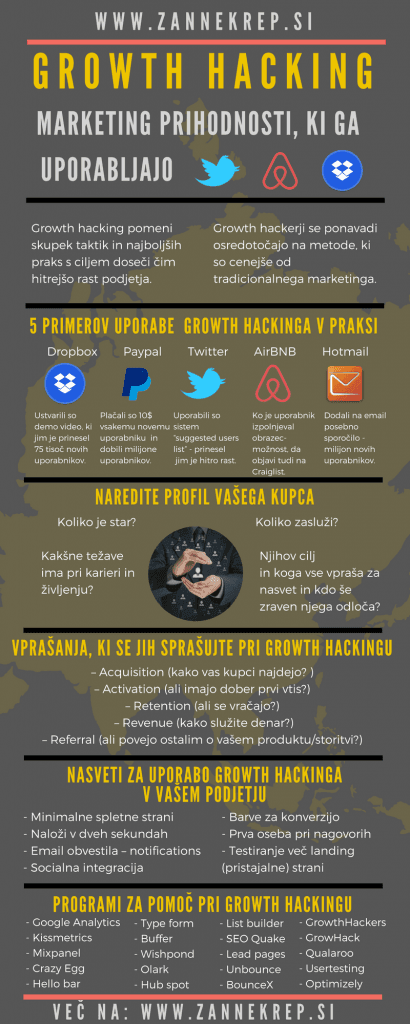

Growth hacking refers to a set of tactics and best practices with the goal of achieving the fastest possible company growth.
The term was first mentioned by Sean Ellis and is extremely popular among start-up companies. Growth hackers typically focus on methods that are cheaper than traditional marketing, such as using social media, viral marketing, or targeted advertising. Growth means growth. Hacking means a smart and practical way of using technology to achieve a certain level of growth.
5 examples of Growth hacking in practice:1.) Dropbox
They created a demo video which they published on Digg, which brought them 75 thousand new users. They also gained millions of users through mutual user referrals. They also simplified the registration process.
2.)Paypal
They paid $10 to each new user and to the person who referred them. With this method they gained millions of users.
3.) Twitter
They used a “suggested users list” system among users, which brought them rapid growth.
4.) AirBNB
When a user filled out a form, they were offered the option to also post what they had written on Craigslist.
5.) Hotmail
Investor Timothy Draper had the idea of adding a special message to every email, which read: “p.s. I love you. Get your hotmail account” and within six months they gained one million users through this method.
Before starting with Growth hacking, create your buyer profile:
– How old are they?
– How much do they earn?
– What problems do they have in their career and life?
– What is their goal?
– Who do they ask for advice and who else besides them is a decision-maker?
Data is of key importance for growth hackers, as it will help you make smart decisions based on multiple tests. Smart decisions can be made by using the free tool Google Analytics, which provides you with information about your product/website. In Growth hacking, don’t forget to also measure the time you put into marketing and correlations (e.g. when a customer visits your website, whether they perform any other activity, visit a subpage).
Growth hacking encompasses the optimization of landing pages, which you use for collecting emails using LeadPages, email marketing using Mailchimp, website optimization – SEO and product optimization, as well as website analysis using Google Analytics and much more.
Use A/B testing, which means having two separate samples of customers: 50 percent of customers see the first website, the other 50 percent see the second, and then the program shows us the results. It is about testing what works better, e.g. which display photos are better, buttons, landing pages, based on the goal we are measuring. Testing is enabled by programs such as Unbounce, which automatically makes the change (if, for example, red is better than blue for clicks on a purchase form). Don’t forget to keep improving your product so it is always better for users.
Questions to ask yourself in Growth hacking (2A and 3R):
– Acquisition: How do customers find you?
– Activation: Do they have a good first impression?
– Retention: Do they come back?
– Revenue: How do you make money?
– Referral: Do they tell others about your product/service?
Tips for using Growth hacking in your company:
- Consider using a minimal website, as they have better conversions (examples of such websites are Dropbox and Groupon).
- Your website should load in two seconds (a 1 second delay reduces the conversion rate by 7% according to Kissmetrics).
- Use email notifications (e.g. Twitter uses weekly notifications).
- Social integration is important, e.g. account registration linked to a Facebook account.
- The best conversions come with the following colors: use red for headlines; green and orange for a call to action.
- Use first person in calls to action (e.g. send me a free copy).
- As a rule, test multiple options weekly: e.g. landing pages, products and sign-up options, to get as many results as possible.
Tools that will help you with Growth Hacking:
- Google Analytics
- Kissmetrics
- Mixpanel
- Crazy Egg
- Hello bar
- optimizely
- Visual Website Optimizer
- Type form
- Buffer
- Wishpond
- Olark
- User testing
- Customer.io
- Hub spot
- List builder
- SEO Quake
- Lead pages
- unbounce
- bounceX
- Qualaroo
- Nimble
- colibri
- click to Tweet
- pay with a Tweet
Growth hackers I recommend:
5 best books/courses in this field:
Websites I recommend: