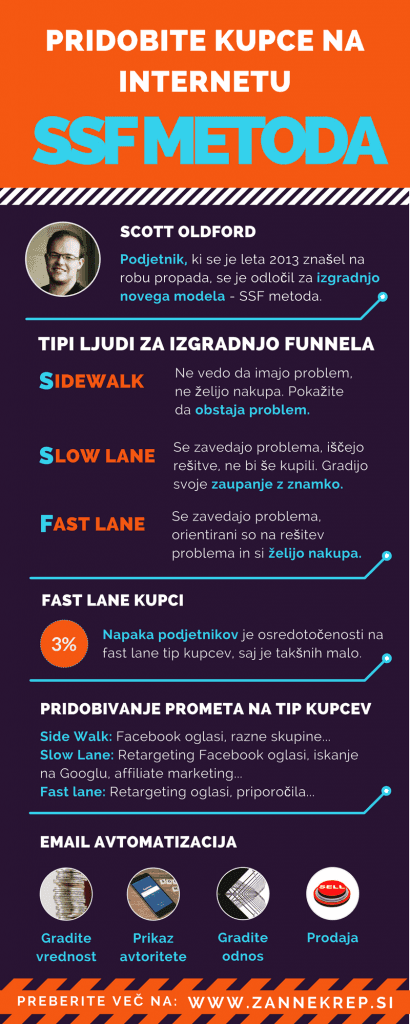
Scott Oldford has been an entrepreneur for a very long time, but in 2013 he was on the verge of collapse and a whopping $726 thousand in debt, which led him to decide on a new business model.
He dedicated all his time to building a video course, which he offered online under the name LeadCraft.
Scott talks about funnels, or sales funnels, which most people know in the following way: you have a Facebook ad for your offer that then brings the customer to a landing page, where you collect the customer’s email and use it for email marketing with the goal of making a sale.
Scott says this no longer works, as Facebook advertising is already being used by millions of advertisers, and therefore Scott recommends the SSF method (Sidewalk, Slow lane, and Fast lane), which he calls the improved funnel.
According to this method, there are three different types of people in funnels:
- Sidewalk: People don’t even know they have a problem, are not ready to buy, and don’t care about you. Your goal is to capture their interest by showing them that a problem exists.
- Slow lane: People are aware of their problem and are looking for new knowledge, but are not yet ready to buy. However, they are willing to build trust with a brand.
- Fast lane: People are aware of the problem, want to make a purchase, and are oriented toward solving their problem.
According to Scott, we must therefore use three different approaches for our sales funnel and adapt our strategy to these findings. It’s not enough to have just one lead magnet (useful content that we give away for free in exchange for a specific action, for example, the customer trusting us with their email), but it is very important that you create a separate lead magnet for each type of person (sidewalk, slow lane, and fast lane).
Using Scott’s SSF method in practice:
Have at least 2 different pieces of content and multiple different lead magnets, as well as 3 landing pages, email automations, and customer acquisition methods. The lead magnets Scott recommends should be, for the sidewalk, for example, a guide that is six to eight pages long. For the slow lane, it should be longer, for example 30 pages or three video recordings approximately 15 minutes long. For the fast lane, use a webinar or a longer video recording. With landing pages, the average conversion rate is 3 to 10 percent. Scott says that with the sidewalk you can achieve a 20 to 40 percent conversion rate, with the slow lane 40 to 60 percent, and with the fast lane 60 to 85 percent. It is therefore important that you have different landing pages, as this allows you to achieve higher conversion rates. For the sidewalk, the landing page should be as short as possible. You have 7 seconds to capture their attention. For the slow lane, it should be a bit longer and include a headline, subheadline, social proof, and more information than the sidewalk. You have around 10-13 seconds to capture their attention. For the fast lane, the page is still short but contains even more information and 3 to 5 benefits. Each landing page must therefore be tailored to the type of buyer.
Use email automation, where you have several email options:
- Build value: With a blog.
- Demonstrate authority: You show authority through what you know or through social proof.
- Build relationships: You build relationships by asking questions.
- Sales: You sell through promotional emails.
For the sidewalk, use emails that will show them they have a problem; for the slow lane, the goal is to educate and present yourself as an authority for solving the problem they have. For the fast lane, the goal is to turn your email recipient into your buyer.
The traffic acquisition methods you use based on the type of buyer are:
- Sidewalk: Facebook ads, various groups, etc.
- Slow lane: Retargeting Facebook ads, organic and paid Google search, affiliate marketing, etc.
- Fast lane: Retargeting ads, referrals, etc.
The more complex the product or service you offer, the more time you need to explain to a potential buyer how it works. The goal of a funnel is to convert visits into conversions and then into customers. The types of conversion methods according to Scott are online webinars, video sales letters or web sales letters, online stores, phone calls, seminars, etc.
Scott advises that when selling services and setting their prices, you follow these rules:
- If the price you are offering is under $200, use a sales page or video sales letter.
- If the price is between $200 and $1,000, use a webinar.
- If the price is over $1,000, use, for example, a seminar.
You can generate much more profit by increasing the average lifetime purchase value of your customers (life-time value). In his business, the average lifetime purchase value (life-time value) of a customer is $3,491.20, while the first purchase in his business amounts to $997.
I also recommend Scott’s blog Infinitus.