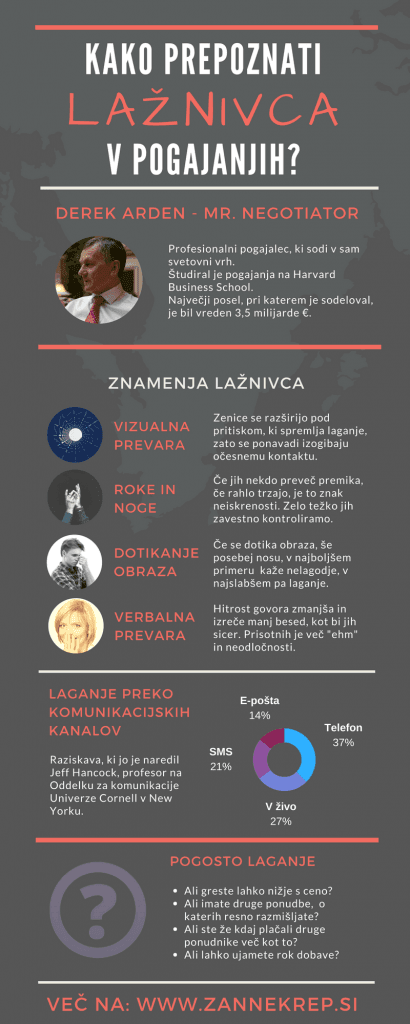

Derek Arden is a professional negotiator who ranks among the world’s top experts in the field of business negotiations.
The media has given him the name Mr. Negotiator. He studied negotiation at Harvard Business School and the largest deal in which he participated as a negotiator was worth 3.5 billion EUR.
What are the signs that tell you someone is lying?
When people lie, they unknowingly give themselves away in several ways. If you pay attention to these signs and ask additional questions, you will quickly and with a fairly high probability determine that someone is lying or manipulating the facts.
- Visual “deception”: Eyes are always a good indicator of deception. When people lie, they usually avoid eye contact with their conversation partner. Good liars are aware of this and can maintain prolonged eye contact. However, even in this case, a liar’s pupils will dilate under the pressure that accompanies lying.
- Hands and legs: If someone moves them too much, if they twitch slightly, this is a sign of nervousness or dishonesty. Hands and legs are very difficult to consciously control.
- Touching the face and nose: If someone touches their face, especially their nose, this is at best a sign of discomfort, and at worst a sign of lying. Do you remember the story of Pinocchio, whose nose grows because he lies? Interestingly, the “growing nose” associated with lies is a real physiological phenomenon. When we lie and feel uncomfortable, special substances (catecholamines) are released in the body, which cause the nose to itch. At the same time, blood pressure in the nose increases and blood flow speeds up, so the nose really does “grow” ever so slightly. Of course, this cannot be observed, but the person who is lying starts to feel a slight itch in their nose, which can quickly be followed by touching the nose with their hand.
- Covering the mouth: Covering the words coming from the mouth with a hand is another classic gesture of deception, most commonly seen in children. A child covers their mouth to physically prevent words from reaching their parents.
- The blinking liar: An increased rate of blinking indicates that a person is uncomfortable, tense, or simply lying.
- Verbal deception: With verbal deception, the speed of voice/speech may decrease and the person will say fewer words than they otherwise would. In general, there are more pauses, hesitations, and “um”s. The length of responses received from the person also decreases significantly.
The following often increase during lying:
- Pitch of voice
- Number of “um”s
- Hesitation when answering / delaying a response
- Number of slips and mistakes
Why? Because telling lies is considerably more taxing on our brains than telling the truth. The brain must use the imagination center in this process and is of course more “occupied” with processing data than usual.
How does Derek detect liars in negotiations?
He has found that people most often lie in business when asked the following questions:
- Can you go lower on the price?
- Have you ever gone lower on the price?
- Are the other offers you have ones you are seriously considering?
- Have you ever paid other suppliers more than this?
- Can you meet the agreed delivery deadline?
When asking these questions, watch and listen carefully to the answers you receive. You will receive valuable information.
And here is an interesting study conducted by Jeff Hancock, a professor in the Department of Communication at Cornell University in New York, in which he found that the following percentage of people would lie through these communication channels:
- 37% would lie over the phone,
- 27% in person,
- 21% via SMS,
- 14% via email.