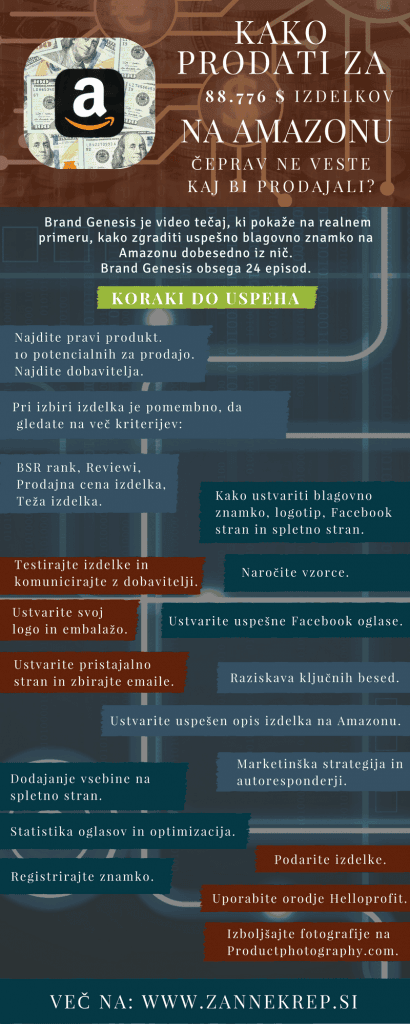

This time I have summarized a course for you that took me approximately 15 hours in total.
It is called Brand Genesis and it is a video course that shows, using a real example, how to build a successful brand on Amazon literally from scratch. Through this demonstration, Matt Clark, a leader at Amazing, earned over $80,000 on Amazon. For those who don’t know what Amazing is – it is a paid video platform (costs $39 per month) where successful entrepreneurs share their knowledge and help millions of people around the world build successful businesses. I personally also use the Amazing platform to learn about entrepreneurship.
Brand Genesis consists of 24 episodes, so I will describe each one individually.
Episode 1
This episode covers finding the right product. After completing it, you will have prepared 10 potential products in Excel and already contacted suppliers on Alibaba. To create a brand, you must first find a product, then find a supplier, and later the supplier delivers the product to Amazon – while your key task will be marketing.
When choosing a product, it is important to look at the following criteria:
- BSR, the so-called best seller rank: Matt advises that it should be between 500 and 1500. You can see the BSR rank in product descriptions on Amazon.
- Reviews: Customer reviews – there should be as few as possible so that you can be competitive.
- Product selling price: This should be between $25 and $60.
- Product weight: This should be under 5 pounds.
Suppliers can be contacted through Alibaba. You can also find quite a few scammers here, so when searching for suppliers it is necessary to check the following criteria: trade assurance, gold supplier, and assessed supplier. Next comes ordering a sample from the supplier. In the case of the Brand Genesis course, Matt decided on a product – gymnastics rings.
Episode 2
In it, Matt teaches you how to create a brand, logo, Facebook page, and website. Matt chooses the name Furry Fitness for his product. When choosing a logo, it is important to think about how the logo will look on the product, a t-shirt, packaging, website, etc. He suggests using Fiverr or 99Designs to create a logo. The website should be simple with customer testimonials at the top and a link to the product sale on Amazon.
Episode 3
This covers ordering a sample, which you order from different suppliers so you can test various products. He advises paying for the sample via PayPal.
Episode 4
This explains how to set up successful Facebook ads and also mentions product research. Example of a Facebook ad that Matt uses to collect likes for his product: Want Free Fitness Gear? Like our page now for exclusive coupons and deals for our new gear! The budget you use for Facebook ads should be approximately €15 per day. He chose inexpensive countries for advertising: Australia, Canada, the United Kingdom, India, Mexico, New Zealand, the Philippines, Pakistan, and South Africa (to get cheap likes). He first suggests focusing on these to gain your first fans and then moving on to other markets, such as the United States, once you already have at least 1,000-2,000 fans of your Facebook page. For product research, search on Google and forums to find out what people are saying about the product itself (for example, Matt compared the difference between wooden and plastic rings for his product).
Episode 5
This covers testing the samples you have received. Test them in different environments and choose the supplier with the best price who also has good packaging options.
Episode 6
This episode focuses on communication with your supplier. You should find out what the minimum order quantity is and how long delivery takes. Negotiate the price and pay 30 percent upfront. In the episode, Matt shows how he lowered the shipping cost via DHL by $2,000. Use the programs camelcamelcamel and Keepa to check historical product prices and much more. Check what the product will actually cost you and what your profit will be, so it is recommended that you use a program such as Fetcher.
Episode 7
In this episode, Matt explains how you need to tell your supplier how the logo should appear on the packaging, what text should go where, etc. Also create a barcode, for example through Cheap UPC barcode, and order business cards with a coupon to include with the product, thanking each customer for purchasing your item. In this episode, Matt also pays the remaining balance and actually places the product order.
Episode 8
Matt shows how to create a landing page for collecting email contacts. Get an email provider such as Aweber and install the analytics tracking tool Google Analytics. For landing pages, Matt recommends using Leadpages, which I already mentioned in the article about marketing automation.
Episode 9
This covers keyword research for finding products of your type and listing on Amazon. A listing refers to how you are ranked on Amazon. Keywords are essential for ranking on Amazon. Use Merchantwords (shows how many searches there are on Amazon) and Keyword External Planner (which shows the number of searches on Google), which I mentioned in the post about Ramit. Choose keywords with the highest number of monthly searches (at least above 10,000). For your listing, look at how your competition on Amazon has set theirs up, so you know which category to start with for your product. You can always change your listing.
Episode 10
In this episode, Matt explains how to create a successful product description on Amazon. Use your competitors’ descriptions as a reference. The description should include the benefits that set you apart from others, using bullet points and the keywords you want to target.
Episode 11
You may need to modify your listing according to Amazon’s requirements. It is very important to thoroughly review your listing for spelling and grammatical errors before publishing it. In this episode, Matt explains what it looks like when you receive your product inventory and that you must not forget to keep at least one unit for photos. If the product is from outside America — which in your case will be from China — it must state “Made in” (the country where it was made). Check that the UPC barcode matches the listing. Also check the weight of the product with packaging and the weight of the product without packaging.
Episode 12
In this episode, you prepare a marketing strategy that includes a Facebook ad for the landing page and autoresponders for everyone who signs up on the landing page. Autoresponders are automatic messages that customers receive when they sign up to your email list. It is also very important to have professional photos taken of your product.
Episode 13
If you have done everything correctly, your product is already available on Amazon. Matt shows you here how to use Amazon promotions. In this episode, it is also important to optimize your Facebook ads, landing page, and other marketing activities you are using.
Episode 14
At this stage, set up the remaining autoresponders (automated emails). Matt also recommends using Feedback Genius. For tracking the performance of your marketing campaigns, use the Campaign URL builder.
Episode 15
In this episode, Matt teaches how to use Amazon sponsored ads, which will also help you with ranking your products. Matt also recommends contacting Amazon top reviewers, who will help you with descriptions. You can find them by typing “Amazon top reviewers” into the Google search engine. When selecting reviewers, it is important to check whether they give 5-star ratings.
Episode 16
Matt recommends checking out the video course titled Advanced Product Marketing on Amazon by Mike McClary on Amazing.com. He also shows how to create an ad on Amazon – it’s important to know that the cost per click should be $0.50 and the starting budget $100 for one month of advertising.
Episode 17
This episode is about adding content to a website. In his example, Matt added useful content for his product (a YouTube video with helpful exercises). He also used the AMZ tracker tool, which will help him get even more reviews (customer opinions).
Episode 18
This episode demonstrates how to review ad statistics and check products before actually putting them up for sale on Amazon. It is very important to review your ad statistics and optimize them.
Episode 19
Matt teaches us that we can register a brand using Legal Zoom. Your product is now already selling on Amazon.
Episode 20
Matt shows how important it is to do giveaways (he gave away 300 to 400). Giveaways in this case are products that you give to customers.
Episode 21
Review your statistics, e.g. whether the names are more male or female (you can specify gender). At this stage, create a Facebook ad targeting the United States. He also chose detailed targeting (specific targeting – in his case, something from the fitness niche). He selected a budget of $150 and ran the ad for two days.
Episode 22
This episode shows the use of the Helloprofit tool. Matt managed to make €600 profit per week with his product.
Episode 23
Matt had his photos improved at productphotography.com. He also used Lightning Deals.
Episode 24
In the final episode, Matt shares everything he learned. He suggests avoiding products with multiple variations. Amazon Sponsored Ads proved effective for him – for example, a Lightning Deal generated $4,000 in revenue in a single day.
Authorities in the field of selling products on Amazon that I recommend:
– Matt Clark
– Jason Katzenback
– Scott Volker