
Frank Kern teaches his knowledge at seminars that cost up to 25 thousand dollars per person.
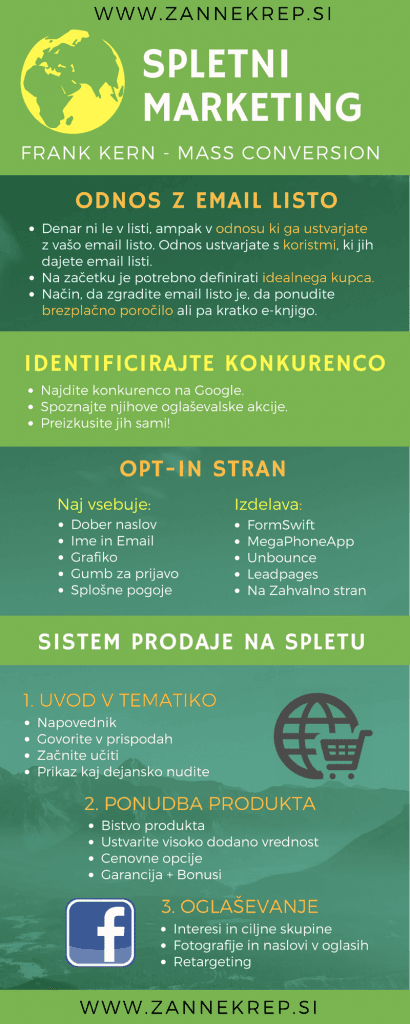
Many consider Kern to be one of the greatest “online marketing gurus” in the world. This time I have described his system for you, which is called Mass Conversion.
The money is not just in your email list, but in the relationship you build with your email list. You build that relationship through the value you provide to your email list. You need to be aware that some people on your email list, regardless of what you do, will not buy from you. At the beginning, it is important to define your ideal customer: determine the characteristics of people who will buy and those who won’t (name, gender, age, appearance — ask yourself for example whether they wear glasses, occupation and how much they earn, single/married, etc.). The method you use to build your email list is to offer, for example, a free report or a short e-book in exchange for your potential customer’s email. The format Kern recommends is, for example, a report in PDF format along with a video recording. Videos have a higher perceived value among customers, so they are worth using when collecting your customers’ emails as well.
Identify the TOP 20 competitors in the Google search engine (find their Facebook pages, sign up to their email lists) and later test the effectiveness with advertising campaigns similar to those of your competitors, and advertise your offer to their fans on Facebook.
The best website for collecting emails (opt-in page) should, according to Kern, contain a very good headline at the top, name, email, a graphic on the left such as a photo of the e-book, and text for the e-book next to the photo. The sign-up button should be on the bottom right. Don’t forget the terms and conditions, where Frank advises creating them using FormSwift. For building websites, Frank uses Megaphoneapp, Unbounce, or Leadpages. When a customer signs up to the email list, they should land on a thank-you page that immediately presents some kind of offer (preferably in video format). For the video on the thank-you page, he recommends using Wistia.
The system Frank Kern uses to sell his information products online and how he uses online marketing:
– Start as if you were talking about a trailer and tell listeners everything they will learn.
– Ask listeners to take out a piece of paper and a pen.
– Start with a countdown and speak in metaphors to listeners, for example: imagine the following scenario…
– Ask questions such as “what if I showed you” and keep the questions focused on results.
– Show something skeptical, then resolve it and offer a solution, while being honest and authentic.
– At this stage, begin teaching and present what you can actually offer them.
– When describing the offer, set a deadline, tell the story of how you used this product and describe the benefit you gained from it. At the end, say that they can get the same product too.
How to explain your product offer, for example in a video, according to Frank Kern:
- First, explain the essence of your product: focus on three benefits and explain them well, then focus on one core benefit.
- Create high added value for the product using three methods: Other products sell for (price), but they don’t have (benefit) like your product does. This product normally sells for (price), and if you were to try to achieve on your own what this product offers you, it would cost you (price).
- Offer 3 installments or a one-time payment at a lower price, and at that moment give them the opportunity to get the product at a reduced price.
- Offer a guarantee that is clear, and two bonuses with your offer.
- Provide a reason why they should order immediately, e.g., the price will go up, the bonuses will no longer be available, or the offer will be withdrawn.
- Repeat the entire offer and bonuses once more, and mention the guarantee and why they should order today.
For advertising, he recommends Facebook ads, where the following needs to be tested and verified:
- Various interests that you target.
- Custom audiences. These are email contacts from your existing customer base or potential customers that you target based on activities they perform on your website.
- Gender – Frank found that there can be large differences between genders when advertising on Facebook. For example, for men who registered for their event, he was paying $69 per conversion (the cost for someone to make a purchase), while for women it was over $300 in some cases.
- Age – He tested 4 different age groups for his product: 25-34, 35-44, 45-54, and age 55+.
- Differences in purchases by day of the week – On one of our projects, Monday proved to be the best day for purchases when advertising through Facebook. Sunday turned out to be the worst day.
- Photos in ads, which are said to account for as much as 70% of the importance of a Facebook ad itself.
- Headlines in ads – What works well for every market is, for example, HOW TO… great benefit..RIGHT NOW, or a question such as Would you like to learn + great benefit for free.
- Facebook ads don’t always need to be changed. Frank shows in his training a method where he runs the same ads for 2 to 3 months. After 3 months he replaces them.
- Amount of text in ads – In their experience, shorter texts performed better than longer ones.
- Retargeting – Repeating ads to those who have already shown interest in your products or services in the past. Frank recommends using AdRoll for retargeting.
- Also test different ad placements. When choosing a Facebook ad, you have the option of desktop news feed, mobile news feed, and right column. Don’t put all options into one ad so that you can test them. Mobile ads typically have more clicks, but that doesn’t mean they also have more conversions.
- Use targeting – You want to know who they follow (who is, for example, the leading figure in your niche), what interests them (e.g. which blogs, magazines, etc.) and don’t forget the Facebook tracking pixel (with the code you set up on your website, you will measure the activities of people you advertise to on Facebook).