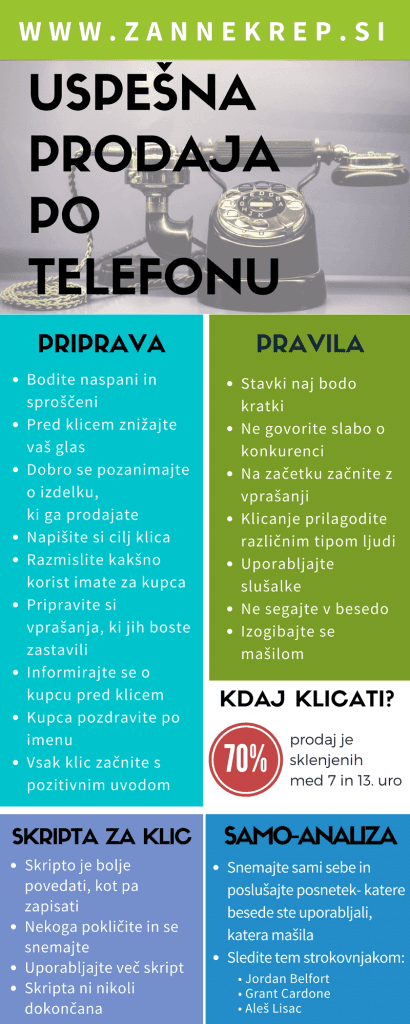

As with any business activity, preparation is very important before making phone calls.
You should know that the goal of calling is not always just to make a sale, as there can be several other objectives, for example, having a customer visit a website, scheduling a meeting appointment, etc. Phone calls are different because you cannot see the person you are speaking with. Research shows that it is better to walk around while on the phone, as you breathe more easily and speak better. Use a headset and microphone, as you can move your hands and have a better conversation.
Preparation before calling should include:
- be well-rested and relaxed, breathing exercises can also help
- your voice is very important – if you are nervous your voice will be higher, so lower your voice before the call
- get to know the product or service you are selling very well
- write down the goal you want to achieve with the call
- think about what benefit you have for the customer and why they should listen to you
- prepare questions you will ask the customer, as well as answers and a story with benefits for the customer about the product you are selling (this is called a calling script – keep it with you during calls and try to memorize it, as you will then know the answers to all objections, e.g. the product is too expensive)
- practice makes perfect (I recommend practicing by recording yourself before calling and listening to how your phone sales work)
- research the customer before the call
- if possible, greet the customer by name (so check their name before the call)
- it will be easier if you have tried the product yourself and trust it
- start every call with a positive introduction and avoid negative openings, e.g. bad news
How to create a calling script?
It is better to speak the script than to write it. This means you speak first and write it down later, as otherwise you will end up with longer sentences, commas, formal words, etc. The easiest way is to call someone, record yourself, then transcribe it and use it as your initial calling script. A script is never finished and is always being improved. Use multiple scripts, as it is different when speaking with, for example, a student versus a retiree.
When is the best time to call?
It varies in every industry. It also depends on whether you are selling to individuals or businesses. Walter Hailey says that 70 percent of sales are closed between 7 and 1 pm, 20 percent between 1 and 4 pm, and only 10 percent after 4 pm.
Rules to follow during a call:
- keep sentences short
- do not speak badly about the competition
- use the right words, e.g. agreement instead of contract, challenge instead of problem, own instead of buy, investment instead of costs, etc.
- start with questions at the beginning
- adapt your calling style to different types of people (this is taught by neuro-linguistic programming)
- use a headset, as it will be easier to speak (for example, you can use your hands while talking)
- some people use a mirror while calling
- adapt the language of the conversation to different age groups, for example some older people do not know what a banner is
- do not interrupt
- vary your voice (high and low)
- avoid filler words, e.g. um
- speak vividly, for example the water is crystal clear
After calling, do a self-analysis (record conversations – at least yourself, and listen to the recording, as you will be able to see which words you used, which filler words, etc.).
I recommend following these people in the field of calling: