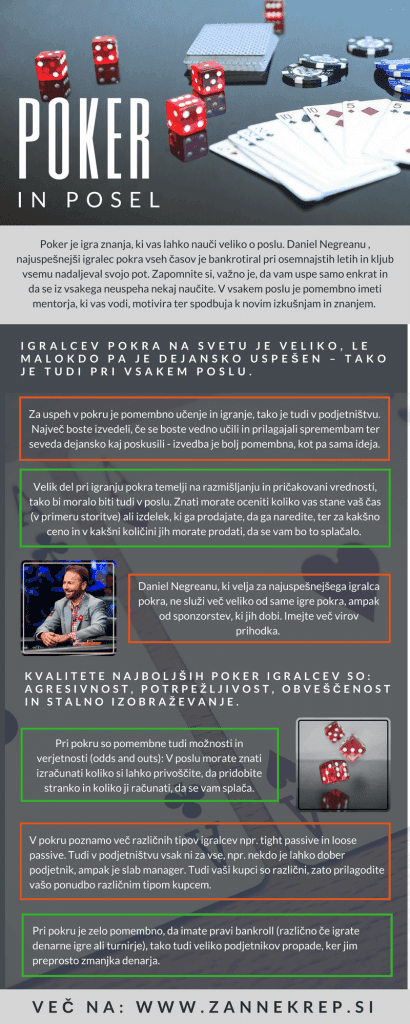

Poker is a game of knowledge that can teach us a lot about business.
Daniel Negreanu , the most successful poker player of all time, went bankrupt at eighteen and continued on his path regardless. In business too, many successful entrepreneurs have gone bankrupt and then succeeded. Remember, you only need to succeed once and try to learn something from every failure. In any business, it is certainly important to have a mentor — Negreanu had one too. A mentor is a person who guides you, motivates you, and encourages you toward new experiences and knowledge.
There are many poker players in the world, but very few are actually successful — the same applies to every business. Success in poker requires learning and playing, and the same is true in entrepreneurship. You will learn the most if you are always learning and adapting to changes, and of course actually trying things out — execution is more important than the idea itself. A large part of playing poker is based on thinking and expected value, and the same should apply in business. You need to be able to assess how much your time costs (in the case of a service) or how much it costs to produce the product you are selling, and at what price and in what quantity you need to sell them to make it worthwhile. In poker, emotional stability is very important, just as it is important in business to know how to react emotionally in the right way, especially when crisis situations arise. Remember that excessive emotionality will hinder you in business, and that numbers never lie. If things are not going well, stop and try something else. It has never been easier to start over, as a wealth of knowledge is at your fingertips and you can do business with practically anyone in the world.
Daniel, who is considered the most successful, no longer earns much from the game of poker itself, but from sponsorships that he receives. In business too, you should not focus on just one source of income — have multiple. In poker, the cards and position matter — if you are last to act, it is easier to make decisions since you can see what your opponents do. In business, position represents location (e.g. a restaurant), which is one of the most important factors, while the cards represent what kind of product you bring to the market. In poker, you have 169 combinations available, and numerous combinations are also possible in business: from whether you are selling to individuals, companies, or the government, to where you will be selling, etc.
Qualities of the best poker players compared to business:
– Aggressiveness: When you have an opportunity with the right product, try to get as much out of it as possible.
– Patience: Wait for situations that are profitable — that is, the right projects in business.
– Being informed: About your opponents — in business, stay informed about your competition and your customers.
– Continuous learning: Important in every business.
In poker, odds and outs are also important: In business, you need to know how to calculate how much you can afford to spend to acquire a customer and how much to charge them to make it worthwhile. In online poker, breaks are very important, as sitting for long periods is harmful. In every business, we need to take a break and clear our heads.
In poker, we know several different types of players — for example, the aggressive player, the beginner, etc. In entrepreneurship too, not everyone is suited for everything — for example, someone can be a good entrepreneur but a poor manager. Your customers are also different, so tailor your offer to different types of customers. In poker, it is very important to have sufficient funds available, i.e. a bankroll (it differs depending on whether you play cash games or tournaments), and similarly many entrepreneurs fail simply because they run out of money. In online poker, there are several programs for playing — for example Hold`em Manager and Poker Tracker — and in entrepreneurship there are several programs that will help you, such as Hootsuite for social media or Active Campaign for email marketing.