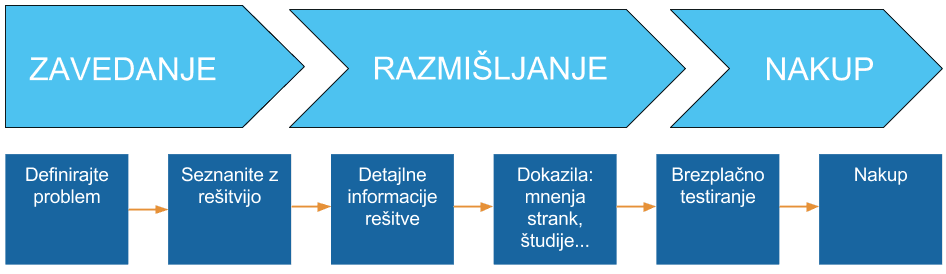
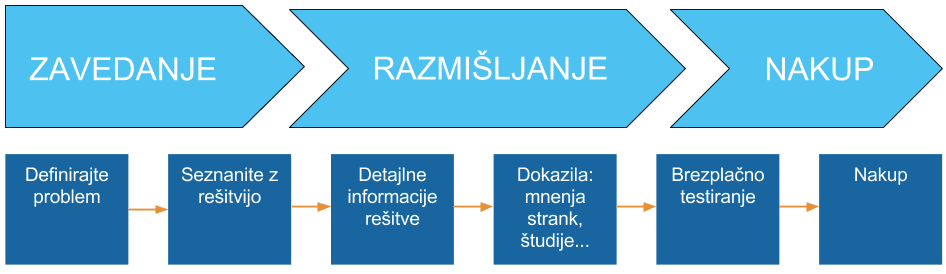
The customer buying cycle is an interesting phenomenon. In the image below, you can see a diagram of a typical customer buying process. It doesn’t even matter whether you’re buying a new car, hair shampoo, or legal assistance from a lawyer – there is a special subconscious process that we all follow. It’s in human nature.
Think about it. What was the last significant purchase you made?
If you’re like most people, when you think back, it probably started with a problem you wanted to solve. The problem doesn’t have to be a major catastrophe; it can be something from your ordinary everyday scenario, such as wanting to look good for an upcoming class reunion, or gaining more clients for your business, or finding an idea of where to take your loved one for your anniversary. In order to solve your problem, you’ll need to do some research, and it all depends on your current level of market knowledge. Your research might include visiting your local shopping center, searching for ideas on Google, reading customer reviews on Amazon, or asking your family or friends for recommendations. After gathering information, the next step is evaluating options – not necessarily from a logical perspective, but from an emotional perspective – for example, how will this product or solution make you feel?
When the solution feels right, all that remains is finding an excellent logical reason to make the purchase, but keep in mind that “the mind will justify what the heart has already decided.”
Once you purchase your product or service and if you truly love it, you’ll become an enthusiastic fan and start telling other people about it. People do this for two main reasons:
- To help others.
- To further justify their purchasing decision. If their friends buy the same solution and like it, they will feel better about their own purchase decision.
This final stage is called a “brand ambassador,” and we strive for all of our customers to ultimately become one. In short – this is essentially the customer buying cycle.
HOW DOES ADVERTISING WORK?
Don’t confuse Google Ads with Facebook advertising. These are two completely different things. In fact, many of the skills required to do excellent work in the Google Ads display network don’t really transfer to Facebook. In a way, Google Ads is actually easier than Facebook advertising (though also more expensive).
The reason for this is that people searching on Google or YouTube are already showing intent. They are actively looking for a solution to their problem, so we can already have an idea of the conversation that may be taking place in their heads.
Looking back at the customer buying cycle, searchers on Google or YouTube have already passed the first step of the buying cycle and are already in the second step of “interest” – they are already looking for information. Think about that.
What was the last thing you searched for on Google? Were you looking for an answer to a question or trying to solve a problem?
With Google Ads display network advertising, the winning strategy is therefore to offer a specific solution to a specific problem. If a pipe bursts in your basement and you see an ad that reads “we fix broken pipes and can be there in 30 minutes,” you’d probably click on that ad, right?
FACEBOOK WORKS DIFFERENTLY
But the previous plumbing ad example wouldn’t work well on Facebook.
Why?
Because Facebook advertising is “interruption marketing” – you redirect an individual’s attention to yourself with a good image, story, or headline. Nobody on Facebook is actively looking for a solution. In fact, there’s a good chance they’re looking for quite the opposite. They’re looking for entertainment, socializing with friends, or watching videos that amuse them.
FACEBOOK’S SUPERPOWER
You’ve probably already heard that Facebook collects an incredible amount of data about its users, including which websites they visit, what they like, and what they click on. In many magazines, I’ve come across references to it as “the most comprehensive dataset of human social behavior.”
But first, let’s answer an important question. Why do audience insights matter at all?
Audience insights provide the data you need to better understand your customers. This data can tell you everything from the age and gender of your customers to where they live and what they like. You can also find out what they think about your brand and what type of content they find most compelling.
It’s important to know how to use the tools available to you to find data about your audience. What you’ve learned can be used to create both organically generated and paid content that truly resonates with your audience.
It’s a win-win situation: your audience gets content that speaks to them, and you can more effectively achieve your marketing goals.
HOW TO FIND YOUR TARGET AUDIENCE ON FACEBOOK
Knowing how to find your target audience is crucial for success not only on Facebook, but also in any segment of your business.
By target audience, I mean the people who are most likely to be very interested in what you offer.
Why does this matter?
There are many reasons, but the most important one is this – not everyone is your customer.
What is a target audience?
Let me show you (explain) this definition with a practical example. A few days ago, I was browsing Facebook, looking at where people had been over the weekend – to get some ideas, see what they had cooked for lunch, and watch a few videos that make me laugh and put me in a good mood. While browsing, an ad for a painting course in Ljubljana appeared on the side. Why was I shown this ad? Before that Facebook browsing session, I had been searching on Google for what kinds of painting courses were available, where, and at what price. Google had therefore analyzed my browsing history and determined that I would most likely be interested in a painting course, and served me that ad on Facebook. I am, after all, the target audience that would be interested in that activity.
How do you identify your target audience?
Technically speaking, a target audience is a selected group of people at whom a marketing campaign is directed.
Wikipedia puts it this way: a target market is a selected group of potential or current consumers that a company decides to direct its marketing and advertising strategies toward in order to sell a product or service.
Often, this “selected group” is defined based on criteria such as:
• Age
• Geographic location
• Browsing habits
• Income bracket
- Gender
- Occupation
- …
Parameters for defining your target audience
Let me give you another example. Let’s say you’re selling your course on the Udemy platform. It teaches people coding (a branch of computer science). You want to run an ad on Facebook to promote it.
Who will you target? Although there are no fixed criteria for defining them, the following will suffice – to name just a few:
• Millennials aged 18 to 30
• People who have shown interest in topics such as Javascript, Python, etc.
• Men (who are generally more interested in coding than women)
• Young professionals
• Holders of a computer science degree
- People who own a laptop
- …
This group of people will most likely match your ideal customer.
What is an ideal customer and how does it differ from a target audience?
Target audience – ideal customer. Both terms refer to any group of people you want to sell to, who are most likely to respond to your marketing campaigns. However, the two terms are not actually the same.
While the term target audience is used to define a broad subset of potential customers, the term ideal customer is much more specific and narrow.
Take the example of the Udemy course I described earlier. Your target audience might be something like:
People living in Ljubljana, aged 18 to 30, in the income bracket of €12,000 to €30,000 per year, male.
You see, that’s quite broad.
For the term ideal customer, you can start with a fictional character. Let’s call him Peter. Peter lives in Ljubljana. He has previously purchased a course on Udemy. He also has a degree in computer science. He spends a lot of time watching various courses on YouTube. He is 25 years old and unmarried.
That’s much more specific and narrow, isn’t it? Well, that’s what an ideal customer is.
So why is it important to find your target audience?
Because once you define your target market or target audience, you will spend the money you invest in an ad effectively. If you advertise to everyone, in most cases the money goes to waste. You will be throwing away your money and time.
Other benefits of targeting the right audience
In addition to helping you avoid wasting money and time, knowing your audience has many other benefits. These are:
a) The right audience can help you create your product
You want to create and launch a new product on the market. What features do you need to build into it? Knowing who will use this product will help you answer that question. So don’t guess and don’t assume. It can cost you a lot.
b) Creating a personalized experience for your customers
Personalizing the experience of your visitors can help increase conversions and ultimately sales. However, you need to know them well for this to work, which is why you need to segment your audience.
c) Better conversion and sales
Have you ever wondered why Facebook always seems to read your mind? You open your Facebook and the sneakers you’ve been wanting to buy for a long time appear in an ad as you browse through your friends’ posts. This happens because Facebook advertisers, who have studied your browsing history, know that you are a potential customer. And needless to say, you are their target audience.
d) Conduct audience research
If you don’t ask, you may never find out who your ideal customers are and what they want. And because you don’t ask, you fall into the trap of incorrect assumptions. So do the work that most people don’t do and conduct research on your target audience. The easiest way to get information is through a survey.
How to find your target audience
There is no single method for finding your target audience. In fact, there are a huge number of methods you can use.
Below I have written out some steps that I believe are not difficult to master, are easy to implement, and won’t cost you too much money invested.
Step 1: Create a Facebook page
Creating a Facebook page for your business (the service or product you are selling) is the first thing you need to do. You probably already have your personal Facebook profile. However, to represent your business activity within a company, it is essential that you have your own Facebook business page. Creating a page is easy. The platform itself guides you step by step through what you need to do to successfully create it.
Step 2: Create your ad
Once your business page is ready, the next step is creating an ad. But before you create an ad, you need to know your goal — what you want to achieve with your ad. By this I mean you need to figure out what you want to accomplish with your ad.
So, what could your goals be? Here are some suggestions:
1. To drive traffic or sales to your website
2. To tell as many people as possible about your business/product and what you offer
3. To get people to purchase your product or service
4. To generate potential customers who will purchase your product or service, or multiple of them, in the future
5. To encourage potential customers to install your app
6. Etc…
So, what is your goal that you want to achieve with your ad?
Step 3: Choose your audience
This is a point that is very important. On Facebook, you can specify the demographics of the people you want to target with your ad. You need to be logged into your Ads Manager account. You have three options for creating an audience: custom audience, lookalike audience, and saved audience. You can always experiment and try what is more effective for you and what brings you better results. First, set a name for the audience you want to create. It can be anything. The next step is to define your audience based on their geographic location. After clicking, select the parameter you want to use for targeting: country or region. I could explain the process in even more detail, but I won’t be writing about that in this article. Namely, once you select the demographic location of your target group, the next step is to refine your targeting a little further. Facebook allows you to select multiple locations at the same time.
Step 4: Refine your audience targeting
Let’s say you want to target people who live in Ljubljana, but that audience is still too broad for you. You might want to narrow it down a bit based on age, interests, gender, etc. To do this, you can select the desired age range, gender, and interests. You could even further refine your targeting by selecting the language spoken by your target audience. If you want even more “fine-tuned” settings, in addition to demographics you can also select the interests and behaviors of your potential customers.
Once you are done refining your target audience, click the “create saved audience” button. You can then use this audience in your marketing campaigns on Facebook and also on Instagram.
AUDIENCE SEGMENTATION
Let me also share one more option for your “ideal” audience on Facebook for you to consider. In today’s article, we have been dealing with an audience that you find yourself based on your research about the ideal customer. But what happens when customers come to your business FB page on their own, without you searching for them? For example, when your potential audience comes from your website rather than Facebook or Google ads.
In this case, not everyone who comes to your FB page will necessarily fit your definition of an “ideal audience.” So how do you then select such people to arrive at your ideal audience? Simply through audience segmentation.
As the name suggests, audience segmentation involves classifying visitors into segments based on parameters such as geo-location, age, gender, spoken language, etc.
Audience segmentation gives you the opportunity to personalize their experience. And secondly, audience segmentation allows you to precisely tailor your marketing message (ad) in a way that resonates well with them. This means greater visibility of your service or product and therefore greater sales for you.
In conclusion …
Finding the right people for your business, service, or product is therefore very important. It will save you a lot of time and money on advertising and marketing to people who will never be interested in your offer.
And if you want to learn even more about Facebook advertising, you have a great opportunity to sign up for the free webinar “How to earn more or sell more with Facebook ads?”.
You can find the registration link here: https://zannekrep.com/brezplacni-webinar4/