
A wallet stores your cryptocurrency, public address, and private key. Although the concept itself is relatively simple, there are numerous small “tricks” happening in the background that make crypto wallets so fascinating.
A crypto wallet is therefore a place where you can securely store your cryptocurrencies. There are many different types of crypto wallets, and in this article we will share with you the key information you need to be able to judge which wallet is right for you. This, of course, depends on what you want to do with your crypto assets and what kind of security net you want to have.
The inner workings of a crypto wallet
When talking about a crypto wallet, the first thing you need to do is forget everything you know about traditional wallets. You need to keep the following in mind:
- from a technical standpoint, you do not use your crypto wallet to store physical or traditional coins;
- all your coins are in fact digital currencies;
- technically speaking, nobody is actually sending you coins. It is really just a matter of updating the state of the blockchain. The blockchain records the number of coins you own – at your address. You are simply “calling up” data from the blockchain. Your coins are therefore not located in your wallet; only the key used to access them is stored there.
The basic principle behind the functionality of a crypto wallet is public key cryptography. Public key cryptography works on the principle of a “key and lock.” This process follows the path below:
1. The text of a file is converted into ciphertext using a public key. This process is also known as encryption.
2. The ciphertext can be decoded back into the file text using a private key. This process is known as decryption.
The logic of a transaction therefore works as follows. If, for example, Peter needs to send 1 BTC to Anja, he will send it to her public address, which is nothing more than a more manageable random hashed version of her private address, which then always remains the same. The hash method works in only one direction: you can create a public address from a private address, but never the other way around. It is impossible to break into a private address through a public address. Anja’s public address can be seen by everyone, and they can send BTC to that address if they wish. Anja can then use her private key to access the sent funds, in our case 1 BTC. As we mentioned earlier, Anja checks the new state of the blockchain after the verified transaction. Both the public and private keys are stored in the crypto wallet. Never publish your private key, as this is similar to giving someone the PIN code of your bank card.
Different types of crypto wallets
Crypto wallets generally fall into the following two categories:
- hot wallets: these are wallets in digital form that are directly connected to the internet. This category includes exchange, mobile, and desktop wallets.
- cold wallets: these are a physical form of wallet that is not connected to the internet. This category includes so-called hardware and paper wallets.
Hot wallets are extremely easy to use. Because they are already connected to the internet, transacting with your crypto coins is very straightforward, however their use constantly exposes you to the risk of hacking or attack.
On the other hand, cold wallets are completely without an internet connection, so you will first need to connect them to the internet if you want to gain access to your coins. Although they are harder to use compared to hot wallets, they are much more secure.
Hot wallets
Your exchange, desktop, and mobile wallets are therefore examples of hot wallets, which are also called online wallets. You can easily access them whenever you want, but they are exposed to much greater risk as they are more frequently targeted by hackers or attackers. Cryptocurrency exchanges are in fact the primary target of these breaches. If you are one of those who regularly carries out crypto transactions, you will likely still want to store some of your cryptocurrency in hot wallets, so it makes sense to take a look at why so-called hot wallets are good and why they are bad to use.
Advantages of hot wallets:
- easy access to your crypto assets;
- a huge variety of options and support that are not platform-dependent;
- very easy to use (e.g. wallets as mobile applications).
Disadvantages of hot wallets:
- high exposure to hackers and malicious attackers;
- if the wallet is damaged/corrupted, you risk permanently losing your entire investment.
EXCHANGE WALLETS (wallets on cryptocurrency exchanges)
If you have been in the world of cryptocurrencies for some time, you most likely already have some experience with the first type of wallet we will introduce. These are exchange wallets. These wallets are easy to use and are automatically created when you set up an account on one of the cryptocurrency exchanges. They can be accessed from various devices, as long as they are connected to the internet.
However, as mentioned above, these are also the riskiest wallets on the market. For this reason, it is advisable to keep a minimal amount of your crypto assets in these wallets. Note that some online wallets are referred to as custodial wallets, as you cannot directly control your keys with the latter. These wallets store your private keys on third-party servers, which raises security concerns.
DESKTOP and MOBILE WALLETS (desktop and mobile wallets)
Desktop wallets are installed on a desktop or laptop computer and provide the user with full control over the wallet – you yourself are the owner of the key. Since the wallets are not on the exchange itself, they are much more secure than so-called exchange wallets. Some well-known desktop wallets are Bitcoin Core, Armory, and Electrum.
There are also types of wallets that are integrated into internet browsers. The most well-known and widely used is MetaMask. MetaMask is a browser extension designed to provide easier access to the Ethereum ecosystem and other ecosystems. Its advantage is fast interaction with dApps. Its disadvantage, however, is that we cannot store native Bitcoin, as it does not support the Bitcoin network.
Mobile wallets perform the same functions as desktop wallets, but on a smartphone or other mobile device. Many mobile wallets can facilitate quick payments in physical stores via near-field communication (NFC) or by scanning a QR code. Mobile wallets are also quite convenient. You simply need to download the wallet from the App Store or Google Play. Bitcoin Wallet, Hive Android, Trust Wallet, and MyCelium are some of the well-known mobile wallets.
The obvious advantages of mobile wallets are the portability and convenience they offer. As more and more people are switching to mobile devices from traditional and laptop computers, the popularity of these wallets is growing. Mobile wallets store your keys and thus allow you to make payments wherever you wish.
What is actually problematic about these wallets? As we have emphasized on multiple occasions, hackers pose a problem, so it is advisable to do thorough research before deciding which one to use.
Cold wallets (cold wallets)

In contrast to hot wallets, cold wallets are devices that are completely without an internet connection. Think of them as a savings bank account for the majority of your coins. So if you want to be a long-term holder, this is the type of wallet you should have.
Advantages:
- a safe place for long-term storage of your crypto assets;
- it is nearly impossible to hack as long as it remains offline.
Disadvantages:
- your crypto assets will not be easily accessible;
- setting up cold wallets can be somewhat complicated;
- you must be very careful not to lose the physical wallet.
HARDWARE WALLETS (hardware wallets)
A hardware wallet is a physical device, most often the size of a thumb drive, that stores the private keys of your cryptocurrencies without using an internet connection. Most people do not use hardware wallets due to their greater complexity and cost. Nevertheless, these wallets do have some advantages – for example, they can keep your crypto assets safe even if someone hacks into your computer. However, due to this advanced security, they are not as easy to use compared to the previously mentioned wallets, and you will also need to spend more money to purchase one.
Despite all this, hardware wallets can also be convenient to use. You can safely store all your cryptocurrencies in one, as they are mostly kept offline. Hardware wallets store your private key and use multiple encryption methods to protect it, so you do not have to rely on the security of your personal computer.
Perhaps at this point you wondered what happens if you lose this device – does that mean all your crypto assets stored in this wallet are lost too? Not exactly. The wallet has a predetermined recovery phrase (“seed phrase”) that can restore your hardware wallet in the event of any damage, loss, or failure.
What exactly is a “seed phrase” or recovery phrase? Imagine that in a “complicated world” you would have to memorize a private key, which is a long combination of various numbers and letters. Instead, we come up with a password that represents this key through encryption. However, if we lose the hardware wallet, our made-up password is of no use to us. This is where the “seed phrase” recovery password comes in – it is a set of random real-world words in a specific sequence. This set of words represents our private address through encryption, through which we can access our funds. Of course, it is very important to first carefully store the recovery phrase in a safe place beforehand.
Hardware wallets are by far the most secure type of crypto wallets, as they store private keys on a physical device that cannot access the internet. These devices resemble a USB drive. When a user wants to perform a transaction with one of their cryptocurrencies on their computer, they plug in the hardware wallet, which can sign transactions without compromising the user’s private keys.
Among hardware wallets, Ledger wallets are the most widespread. The Paris-based company was founded in 2014 and has a production facility in France and offices in San Francisco. At the heart of their innovation is a special operating system called BOLOS, which they integrate either into a secure chip for their wallets or into a Hardware Security Module (HSM) for various business solutions.
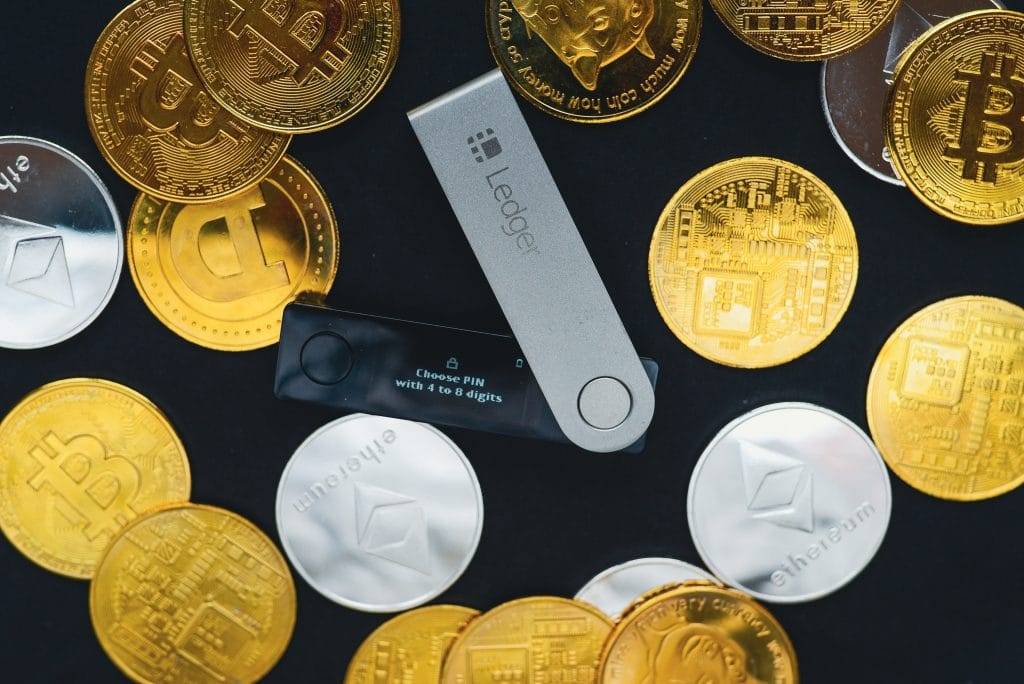
If you are deciding to purchase a hardware wallet, the Ledger Nano S will certainly be among your favorites. Everything you want to know about this wallet can be found in one of our previously published articles, which you can access at this link.
Ledger also offers the excellent Ledger Nano X wallet, which may even be the best hardware wallet in the world. It offers top-level security due to its dual-chip architecture and has a Bluetooth function that allows users to use it with their phone or laptop.
The world’s first secure hardware wallet was the Trezor crypto wallet, developed by SatoshiLabs. Trezor is also a flash drive-like device with an OLED display on top for showing important information, just like the Ledger Nano S. It cannot be infected with malware and never reveals your private keys.
Advantages of hardware wallets
Although we have already touched on this topic somewhat, let’s look at some reasons why it is recommended that a hardware wallet should be placed at the top of your shopping list:
- your private keys will remain undisclosed; under no circumstances will you need to take the private key out of this wallet, and as such the wallet is completely secure;
- the PIN that provides access to your hardware wallet is encrypted. Only you have complete control over your wallet. For example, if you enter the wrong number three times in a Ledger, the wallet goes through a hard factory reset. In any case, you can restore the wallet with the recovery phrase;
- hardware wallets provide support for multiple cryptocurrencies simultaneously;
- you can verify your transactions through the hardware wallet itself, which means you do not need an internet connection.
Best practices for using hardware wallets
- Choose a strong PIN password. Make sure others cannot easily guess it and memorize it. If necessary, write it down and store it in a safe place;
- every hardware wallet has a so-called “recovery sheet”. Store this sheet somewhere safe, as you will need it in emergencies to recover your crypto assets;
- as with all other matters in life, when using a hardware wallet it is also advisable to follow the principle that it is not wise to put “all your eggs in one basket”. Instead of storing all your coins in one hardware wallet, you can simply divide your crypto assets across two or more wallets, if this is financially feasible for you;
- it is very important to keep your wallet in a safe place. Since it is a physical object, it is subject to general wear and tear.
PAPER WALLETS
The most secure way to store coins is by using paper wallets. A paper wallet can be part of software that securely generates a key pair. The QR codes for both keys can be printed and scanned as needed.
A paper wallet is therefore a piece of paper with a printed private and public key. Some paper wallets can also have an optical barcode reader created by an application. This is a way to store and access your cryptocurrency offline. As we have already mentioned, we have crypto assets, but they are inaccessible without your keys. If created in a trusted or secure environment, paper wallets are incredibly secure. No centralized agency or third party is involved, nor can this wallet be hacked. Paper wallets are the most secure but least convenient type of cryptocurrency storage you can use.
Paper wallets were generally used before the world of cryptocurrency became more widely popular. Storage technology has improved since then, but paper wallets still remain a valid way to store keys in certain circumstances.
How to ensure the security of your wallet
Although cold wallets are significantly more secure than hot wallets, you can still follow some best practices to ensure the security of your wallet:
- distribute your crypto assets across different wallets – it is recommended to store a small percentage of cryptocoins in hot wallets, which you can use for everyday transactions and trading. The remaining coins are recommended to be stored in a so-called hardware or paper wallet;
- continuous updates – continuously updating your software is essential to increase bug fixes and enhance security. In addition to the wallet software, you should also update your laptop and mobile phone;
- adding additional security procedures – adding additional security procedures can be quite cumbersome. However, adding a long and complex password, 2FA authentication, and an additional PIN code can be extremely beneficial for greater security of your crypto wallet.
Despite all the information, you should be aware that we are not financial advisors. All decisions regarding cryptocurrencies are made at your own responsibility. Do your own research as well.
In conclusion
We hope this article gives you a clear insight into what crypto wallets are and how indispensable they are on your journey into the world of cryptocurrencies. Depending on the type of trader you are, you will need to choose your wallet or multiple wallets accordingly. If you would like to learn more about cryptocurrencies, you are welcome to join us at a free webinar, which you can access here: https://zannekrep.com/brezplacno20/.