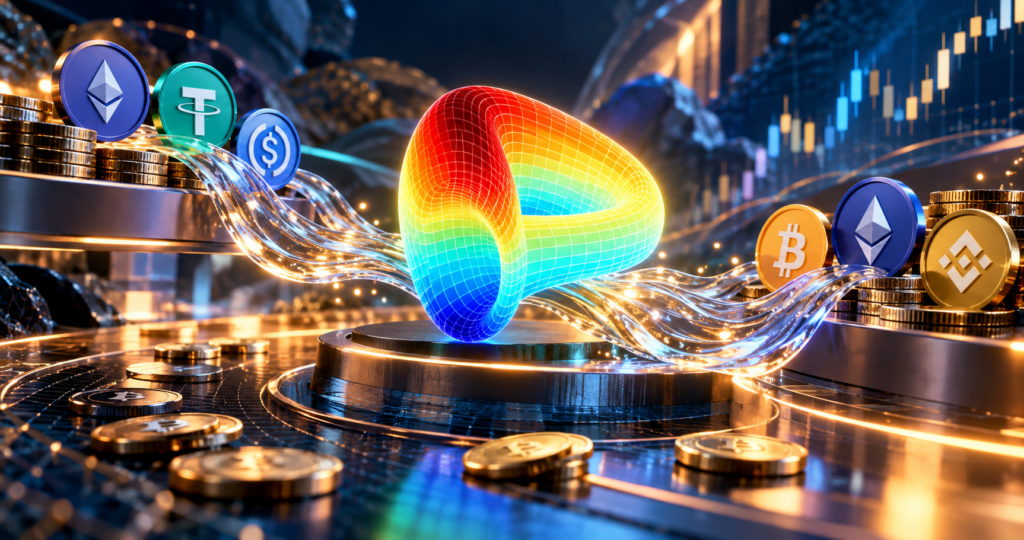
Can you earn money with cryptocurrencies without buying and selling every day? One option is curve.finance, also known as Curve Finance. There you can swap cryptocurrencies or lend them to a shared pool that other people use for their swaps. In return, you can receive a share of the fees, and with some pools, additional rewards as well.
In this article, I’ll show you how to evaluate this option and what you need to get started.
My goal is simple: for you to understand where the earnings would come from before you send money anywhere.
If you’d like to get to know the broader options first, sign up for my free webinar on earning with cryptocurrencies.
What is curve.finance and what can you use it for?
Curve Finance is an online platform for swapping cryptocurrencies. A cryptocurrency is digital money, or a digital asset, that you store and send over the internet.
Curve is a decentralized exchange. This means that the swaps aren’t run by a company with your user account, but by a computer program on a blockchain. A blockchain is a public record of all transactions, maintained by a network of computers.
We call these programs smart contracts. They are essentially code that automatically carries out an action when certain conditions are met. If the code has a bug or someone exploits it, users can lose their funds.
For a beginner, Curve has two main uses: swapping one cryptocurrency for another and depositing funds into a swap pool.
Does Curve Finance work like a regular crypto exchange?
Not quite. On a regular exchange, you open an account, deposit money into it, and handle everything inside the account. On Curve, you use your own crypto wallet and confirm each action with it individually.
A crypto wallet is an app or device that you use to access your cryptocurrencies. Once you deposit funds into a pool, they are subject to that pool’s rules and risks.
That’s why before every confirmation I check three things: what I’m signing, how much it costs, and how I’ll withdraw the funds later. This matters more than chasing the highest percentage.
How can you earn with cryptocurrencies on Curve?
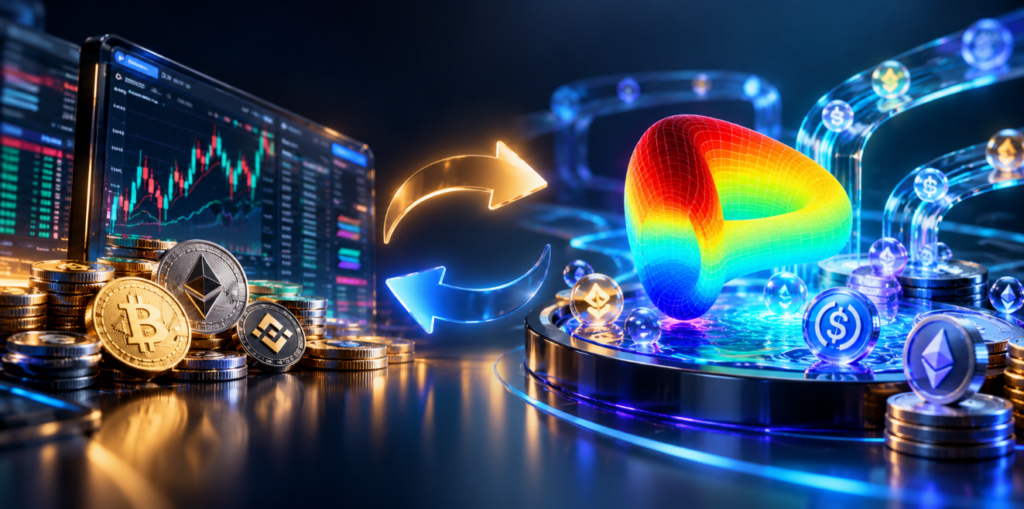
The main option is providing liquidity. Put simply: you lend your cryptocurrencies to a pool so that others can swap with them. Without enough funds in the pool, swaps are more expensive.
Imagine a pool with two cryptocurrencies. Users put one in and take the other out. They pay a fee for each swap, and part of that fee goes to those who deposited funds into the pool.
Such a pool is called a liquidity pool. When you deposit into it, you become a liquidity provider. How much you earn depends on how many people use the pool, what’s in it, what the costs are, and how the value of the assets changes.
So it’s not only about whether the price of a cryptocurrency will rise. It also matters how much people swap, where the payouts come from, and how much the rewards will be worth when you sell them.
Where can your yield come from?
Yield is what your deposit earns over a given period of time. On Curve, it can consist of three parts:
- fees from swaps,
- yield from the assets themselves in some pools,
- additional rewards in tokens (a token is a digital unit of a given project).
These sources are not equally reliable. Fees arise because people actually use the service. Rewards, on the other hand, are often just bait to attract money and can shrink quickly.
When you see a high percentage, first check how much of it is fees and how much is rewards.
Stablecoins: why do you often encounter them on Curve?
A stablecoin tries to maintain the same value as a regular currency, most often the US dollar. One example is USDC: one token is supposed to be worth one dollar.
But “stable” doesn’t mean “safe” or “guaranteed.” Such a cryptocurrency can lose its value. What matters is who issues it and how it maintains its value.
On Curve, there are pools for assets of similar value, as well as other kinds of pools. Always check exactly what is in the pool. Just because two tokens have “USD” in their names doesn’t mean they are equally safe.
What does losing the dollar peg mean?
If a stablecoin fails to hold its target value, we call this a loss of peg, or depeg. If a token that is supposed to be worth $1 fell to $0.85, your deposit would also be worth considerably less.
At the same time, more of the weaker token can accumulate in the pool because people swap it for the better one. As a result, after a while you no longer hold the same ratio of assets that you deposited.
That’s why I ask myself: would I be willing to hold each of these cryptocurrencies on its own? If not, a high yield doesn’t convince me.
What about your result in euros?
If you live and pay in euros, you should also measure your earnings in euros. A token pegged to the dollar is still affected by the exchange rate between the dollar and the euro.
You may end up with more tokens, but they could be worth fewer euros in total. That’s why, when you deposit, write down the value in euros and later compare it with what you would actually get when you exit.
What do you need before using Curve Finance for the first time?
Before your first transaction, you need three things:
- a suitable crypto wallet, e.g. Metamask
- cryptocurrency on the right network,
- some funds to pay network fees.
A transaction is any action on the blockchain, such as a transfer or a swap.
The network is the “road” your transaction travels on. The same cryptocurrency can exist on multiple networks, so it’s not enough to know only its name. You also need to check which network it’s on.
To use the network, you pay a fee called gas. You pay it in the cryptocurrency the network requires. If you don’t have it, you’ll see the funds in your wallet, but you won’t be able to do anything with them.
My checklist before sending funds
Before confirming, I check:
- Does Curve support this network and this cryptocurrency?
- Am I sending to the same network the recipient is on?
- Do I understand which pool I’m depositing into?
- Do I have enough funds to get in and to get out later?
- Could I afford to lose this amount?
For my first attempt, I choose a smaller amount, but only after checking the costs. If the fees would eat up a large part of the amount, I first just look around without depositing anything. You don’t have to pay to learn.
If wallets, networks, and swaps are still unfamiliar to you, first check out my free webinar for beginners in the world of cryptocurrencies.
How do I check an individual pool on curve.finance?
On the official site, I open the list of pools and select the network. Then I click on a pool and read what’s in it, what the yields are, and how I can withdraw my funds. The fact that a pool is on Curve doesn’t mean to me that it’s a good one.
I always go in order: first the pool’s contents, then the costs, and only at the end the percentage. That way a nice-looking number doesn’t mislead me.
1. I check each cryptocurrency separately
For every asset, I want to know what it is, how it maintains its value, and where I can find information about it. If I can’t explain it in simple words, I don’t understand the pool yet.
I also check the contract address. It’s a kind of “ID card” for a token on a particular network. The same name doesn’t necessarily mean it’s the real token.
2. I check the pool’s size and usage
For pools, you’ll see the label TVL. This is the total value of everything deposited in the pool. It tells you how big the pool is, but not how safe it is.
Trading volume tells you how much people swapped over a certain period. I check what time period the number covers and compare it to the pool’s size. One good day doesn’t mean steady earnings.
3. I check the distribution of assets
If a pool has much more of one cryptocurrency than the other, I want to know why. It may be normal, but it may also mean people are quickly getting rid of something.
That’s why I also look at asset prices and official announcements from the projects. If I can’t explain the difference, I wait before depositing.
4. I check what I need to do to get the displayed rewards
Some rewards require an additional step. So I don’t expect to receive all the displayed yields automatically.
I write down what I get just by depositing and what I get only with additional steps. That way I don’t compare a simple option with a complicated one as if they were the same.
APY and APR: how to understand the displayed percentage?
APR is the annual return without reinvesting your earnings. APY, on the other hand, accounts for the fact that you reinvest your earnings and that they generate returns too.
On Curve you’ll also see the label vAPY. The letter “v” means the yield is variable. It’s calculated from past activity and can change at any time. It’s not a promise for the future.
That’s why I create three scenarios: with the displayed yield, with a lower yield, and with a loss in the value of the principal. The principal is the amount you invest at the start.
How do you make your first swap on Curve Finance?
A swap comes in handy when you need a different cryptocurrency for a pool. The swap itself doesn’t generate a profit. The goal is to get the right asset at a reasonable cost.
First I open the official site curve.finance and check the address in the browser. Then I connect my wallet and select the right network. Connecting your wallet doesn’t mean you’ve allowed the spending of tokens.
In the swap section, I select what I’m giving, what I want to receive, and how much. Before confirming, I check how much I’ll receive and how much the network fee costs.
What do slippage and price impact mean?
Slippage is the difference between what you expected and what you actually got. It happens because conditions change between the moment you click and the moment the trade executes. With the slippage setting, you decide how much of a difference you’re still willing to accept.
Price impact is how much your swap itself moves the price in the pool. This matters mostly with larger amounts.
If a swap fails, I don’t immediately raise the allowed slippage. First I check why it failed. I don’t want a swap to go through while I lose money on it.
How do you add funds to a liquidity pool?
Once I understand the pool and the costs, I choose the Deposit option, which means putting funds in. I enter the amount and check the preview.
In return for your deposit, you receive LP tokens. These are proof of your share of the pool. LP stands for liquidity provider. The number of LP tokens doesn’t necessarily equal the number of coins you deposited.
Before depositing, you may have to click Approve. This allows the program to spend your token. I check who I’m giving permission to and, if possible, limit the amount.
Depositing and staking LP tokens
With some pools, Curve separates depositing from the Stake option. With Stake, you put your LP tokens (liquidity provider, meaning a provider of liquidity. That’s you when you put your cryptocurrencies into a pool so that others can use them for swaps) into a special rewards program called a gauge. This way you can earn additional rewards, if they’re available.
The Deposit & Stake option combines both into one step. Even so, before confirming I check exactly what I’m approving.
On my first try, I write down the pool, the network, the amount, and the costs. Then I check whether my position is displayed correctly. Your position is your current investment in the pool.
How do you claim your earnings and withdraw funds?
Even before I get in, I look at how I’ll get out. I want to know which steps I’ll have to take, what I’ll get back, and how much it will all cost.
If I put my LP tokens into a rewards program, I first have to click Unstake to remove them. Only then can I use Withdraw to take the funds out of the pool.
Claim means collecting your rewards. Claiming, unstaking, and withdrawing are three separate steps. Each may require its own confirmation and its own fee.
When withdrawing, you can sometimes choose a single cryptocurrency or several at once. Before confirming, I check the amounts and warnings.
When is claiming rewards worth it?
If you have €3 in rewards and claiming costs €4, you lose money. Claiming more often doesn’t help you in this case.
On the other hand, waiting means the value of the rewards remains uncertain. That’s why I weigh both when I decide: the cost of claiming and the risk of waiting.
If you want to use your earnings for everyday expenses, you still have to swap them into euros and cash them out. That costs money too, so I include it in my calculation from the start.
CRV: do you need to buy this token?
CRV is Curve’s own token. You don’t need to buy it to use the pools. Buying CRV and investing in a pool are two separate decisions.
If you receive CRV as a reward, its value is not guaranteed. More tokens don’t necessarily mean more euros. I keep track of how many I have and how much I would get for them if I sold.
On Curve, you’ll also come across veCRV. You get it by locking up CRV for a set period. With it, you can vote, receive a share of revenue, and sometimes earn larger rewards.
However, you can’t freely use locked CRV until the end of the period. I wouldn’t recommend this to a beginner for a first attempt. They should first understand depositing, costs, and withdrawing.
My plan for a simple and transparent start
For me, a simple start means few decisions, understandable amounts, and a known exit in advance. It doesn’t mean there’s no risk. Here’s how I would start.
Step one: define your purpose
Write down whether you want to learn or to earn with the cryptocurrencies you already have. If you expect a quick, large profit from a small amount, reread the calculations above.
For learning, you can start by simply browsing the site, without any transaction. That way you see what’s still unclear to you without paying for it.
Step two: choose one understandable pool
Choose just one pool. For each cryptocurrency in it, write one sentence: what it is and why it has value. Then write down where the yield is supposed to come from.
If you can’t write that, take more time. More pools don’t mean more understanding, just more risk.
Step three: calculate the entire cycle
Add up all the costs: purchase, transfer, approval, deposit, claiming rewards, withdrawal, and swapping into euros. Use the actual costs for your network and amount.
You won’t need every step. But it’s important to look at the entire path to payout, not just the cost of the first click.
Step four: track your result using the same yardstick
Regularly write down how many euros you would get if you exited. Subtract all costs, both paid and expected. Then compare that with the amount you invested.
If you’d like an overview of other options, check out my free crypto webinar.
Mistakes that can wipe out your earnings
Choosing based only on the highest percentage
A high percentage can result from temporary rewards, a small pool, or a risky token. That’s why I check what it’s made of and whether the investment would be worthwhile even without the rewards.
I don’t look only at the best-case scenario. I also ask myself what happens if rewards drop, costs rise, or a token loses value.
Moving a small amount too often
Every switch to another pool costs money. If you pay to enter and exit several times because of a slightly higher percentage, you may end up earning less.
Before switching pools, I calculate whether the extra yield will cover the extra costs and risk. If it won’t, the move isn’t worth it.
The wrong address or a dangerous approval
Fake sites can look exactly like the real thing. That’s why I open the site through a verified source and double-check the address before signing. I never give anyone my wallet’s recovery phrase.
A recovery phrase is a secret password that lets anyone take over your wallet. Curve never needs it, so never enter it on a website.
Even if you disconnect your wallet, the approvals you’ve granted remain. That’s why I check them separately after use and revoke them if necessary.
Mistaking rewards for profit
€20 in rewards is not yet €20 in profit. If your deposit has lost €40 in value in the meantime, you’re in the red even before accounting for costs.
I keep the math simple: the value at exit plus the payouts already received, minus all deposits and costs. I just make sure not to count rewards twice.
Frequently asked questions about curve.finance
Can you use Curve Finance without buying CRV?
Yes. CRV is not required for swaps or for depositing into pools. You only need supported cryptocurrencies and some funds for network fees. Always check the terms of the specific pool, though.
Is the yield on Curve guaranteed?
No. The percentages change, and so do the value of the assets and the rewards. Your earnings can be reduced by fees, a bug in the code, a stablecoin losing its peg, or something else. You can also lose your entire deposit.
Can you start with €100?
Technically, sometimes you can, but check the costs first. If they’re too high relative to the expected earnings, it’s better to just look over the pool for now. A small amount doesn’t automatically mean it’s worth it.
Is this passive income from crypto?
Partly. You don’t have to trade every day, but you still need to keep an eye on the value of your assets, the rewards, and the state of the pool. I’d say it’s income with occasional check-ins, not completely effortless.
Are stablecoins comparable to euros in a bank account?
No. They depend on their issuers and rules, and they can lose value. For those pegged to the dollar, the exchange rate between the dollar and the euro matters too. More tokens doesn’t necessarily mean more euros.
What is the first step for a complete beginner?
First, understand how the wallet, the network, and the fees work. Then open a single pool and, without depositing anything, work out what’s in it, where the rewards come from, and how you exit. Only then decide on a small test.
How would I approach the next step myself?
I’d start with one question: do I know how to calculate how much I’m left with after all costs? If not, I first gather the missing information. If so, I then check how much I could lose.
If you want to keep learning, sign up for my free crypto webinar. Then work through a calculation for one example: the deposit, the time period, the potential yield, all costs, and the exit conditions.
That way, you’ll make decisions based on clear numbers. When it comes to earning with crypto, that’s far more useful than chasing the highest percentage.