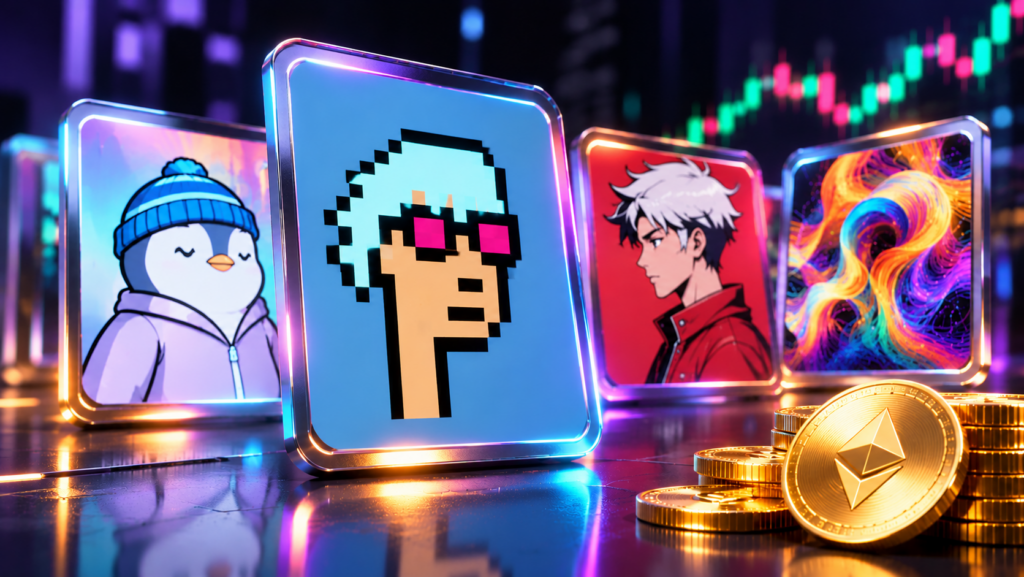
When I first heard about NFTs, I thought it was just a passing trend.
Why would anyone pay for an image that anyone can save to their computer? Then I saw how people were making money with NFTs, and I started digging in. I quickly figured out that most people lose money, while a small group earns consistently. The difference between them isn’t luck, but tools and data.
In this article, I’ll show you the three tools I use for NFTs: CryptoSlam, HowRare and Magic Eden. With them, you’ll see which collections are actually selling, how rare a particular NFT is, and where to buy it. I’ll also show you how to avoid the most common mistakes.
If you’re not yet familiar with the basics of crypto, start by joining my free crypto webinar. In it, I show how I get started and how I make money with cryptocurrencies.
What NFTs Are and How They Work
NFT stands for non-fungible token. It is digital proof of ownership of something unique. Most often it’s a digital image, but it can also be music, an item in a game, a ticket, or membership in a community.
What does “non-fungible” mean? You can swap one euro for another euro and nothing changes. Euros are fungible. An NFT, on the other hand, is unique. Two NFTs from the same collection have different traits and different values.
An NFT exists on the blockchain. This is a public digital ledger in which all transactions are recorded. It shows publicly who owns an NFT. It’s true that anyone can save the image. But there is only one owner of the NFT, and that can be proven.
What an NFT Collection Is
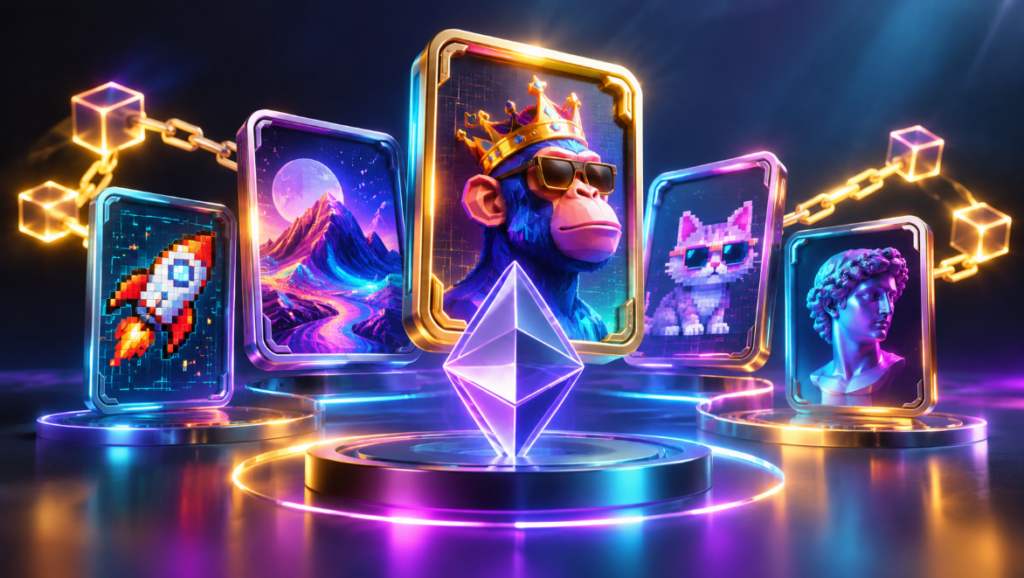
Most NFTs are part of a collection. This is a group of NFTs from the same creator, for example 10,000 characters in the same style. Each character has different traits: a different background, clothing, face, or accessories. Some traits are common, others very rare.
Which Blockchains NFTs Live On
The best-known ones are:
- Ethereum – the largest and oldest NFT blockchain, but with higher fees.
- Solana – fast and cheap, very popular for NFTs and memecoins.
- Bitcoin – has NFT-like records called Ordinals.
A network fee (also known as a gas fee) is the cost you pay for every transaction on the blockchain.
How People Make Money with NFTs
You can make money with NFTs in four main ways:
- Minting and selling. Minting is the first purchase of an NFT directly from the creator, when a collection launches. If the collection is successful, you can soon sell the NFT for more.
- Buying below value. You look for an NFT with rare traits that is listed at the price of a common one, and sell it for more.
- Floor price trading. The floor price is the lowest price at which an NFT from a collection is currently for sale. Some people buy at a low floor price and sell when it rises.
- Ownership perks. Some NFTs provide access to a community, events, or free tokens called an airdrop.
With all four methods, you need data. That’s where tools come in.
CryptoSlam – Where I See What’s Actually Selling
CryptoSlam is a website with NFT data. It tracks NFT sales across multiple blockchains and ranks them by sales volume. For me, this is the first step when I’m looking for a collection worth paying attention to.
What I See on CryptoSlam
- Collection rankings by sales volume over the last 24 hours, 7 days, or 30 days.
- Number of buyers and sellers. More distinct buyers means a healthier collection.
- Number of transactions and the average sale price.
- A comparison of blockchains, so you can see where most of the action is right now.
Why the Number of Buyers Matters
There’s a phenomenon in the NFT market called wash trading. This is fake trading in which the same person sells NFTs to themselves between their own wallets. This creates the appearance of high demand.
CryptoSlam tries to detect and filter out such transactions. Even so, I always check the number of unique buyers. If a collection has a huge trading volume but only a handful of buyers, something is wrong.
How I Use CryptoSlam in Practice
- I open the collection rankings for the last 7 days.
- I select the blockchain I’m interested in, for example Solana.
- I look for collections where the number of buyers is growing, not just the price.
- I write down the collections that interest me and check them first on HowRare and Magic Eden.
This simple process has protected me more than once from a collection that looked successful but whose popularity was driven by only a small circle of people.
HowRare – how rare an NFT really is
HowRare is a tool for checking the rarity of NFTs on Solana. For each supported collection, it calculates how rare an individual NFT is and assigns it a rarity rank.
The rarity rank tells you how rare an NFT is compared to the others in the collection. Rank 1 means the rarest NFT. In a collection of 10,000 NFTs, rank 9,500 is very common.
Why rarity matters for profit
In most collections, rarer NFTs are worth more. On marketplaces, though, owners sometimes list them at the floor price because they don’t know what they have. That’s an opportunity.
My process looks like this:
- On HowRare, I look up the collection I found on CryptoSlam.
- I look at which NFTs have the best rarity rank.
- On the marketplace, I filter for NFTs listed near the floor price.
- I compare their rank with the rank on HowRare.
- If I find a rare NFT priced like a common one, I consider buying it.
What to watch out for with rarity
Rarity isn’t everything. Sometimes an NFT with a somewhat worse rank has a trait that is more popular among collectors. A nice or funny trait can sell for more than a statistically rarer one.
That’s why I use the rarity rank as a guide, not as the only criterion. I always also look at what prices NFTs with similar traits have sold for in the past.
When evaluating, I also rely on sales history. On the marketplace, I look at what prices NFTs with a rank between 1 and 100, between 100 and 500, and the rest sold for. This gives me a sense of how much more buyers actually pay for rarity. In some collections the difference is large, in others it barely exists. If buyers don’t pay for rarity, hunting for rare NFTs in that collection makes no sense.
HowRare also has a calendar of upcoming collection releases. There you can see which collections will soon be available to mint.
I show how I use data to look for opportunities in other cryptocurrencies too, not just NFTs, in the free webinar on making money with cryptocurrencies.
Magic Eden – a marketplace for Solana NFTs
Magic Eden is one of the largest NFT marketplaces on Solana. A marketplace is a website where you buy and sell NFTs.
An important change you need to know about
In the past, Magic Eden also supported Ethereum and Bitcoin NFTs. It shut down those marketplaces and returned to Solana. It also discontinued its wallet. The company is increasingly shifting its focus to other crypto-related services as well.
What this means for you:
- For Solana NFTs, Magic Eden is still one of the main marketplaces.
- For Ethereum NFTs, use a different marketplace, such as OpenSea.
- For active trading on Solana, Tensor, a marketplace for fast NFT trading, is also a good alternative.
Because marketplaces change, check what a particular marketplace currently supports before every purchase.
What you need to buy on Magic Eden
- A Solana wallet, such as Phantom. A wallet is an app where you store cryptocurrencies and NFTs.
- SOL, the cryptocurrency of the Solana network, to buy the NFT and pay fees.
How I buy an NFT on Magic Eden step by step
- I buy SOL on an exchange and send it to my Phantom wallet.
- I open magiceden.io. I always type the address myself or open it from a bookmark.
- I click Connect wallet and connect Phantom.
- I look up the collection I checked on CryptoSlam and HowRare.
- I check whether the collection is verified. Verified collections have a special badge.
- I sort the NFTs by price or filter by traits.
- I choose an NFT, click Buy, and confirm the transaction in my wallet.
After the purchase, the NFT appears in my wallet.
How I sell an NFT
Selling is similar. I open my profile, select the NFT, and click List. I set a price and confirm in my wallet. The NFT stays in my wallet until someone buys it.
When selling, I account for two fees. The first is the marketplace fee. The second is the royalty, which the collection’s creator receives on every sale.
My advice: if I want a quick sale, I always set the price slightly below the nearest competing listings. If I’m not under time pressure, I wait and set a higher price.
How I use these three tools together
Each tool has its own role. Together they form a simple system:
| Tool | What I use it for | Key question |
| CryptoSlam | Finding collections with real demand | Is the collection actually selling, and to whom? |
| HowRare | Assessing the rarity of an individual NFT | Is this NFT rarer than its asking price suggests? |
| Magic Eden | Buying and selling Solana NFTs | What is the floor price, and when should I buy? |
A real-world example. On CryptoSlam, I notice a Solana collection whose number of buyers has been growing for a week. On HowRare, I check the rarity and see that one of the NFTs for sale is ranked 150 out of 5,000. On Magic Eden, it’s listed almost at the floor price. This is a situation in which I consider buying.
But I don’t buy every time I find a case like this. First, I also check whether the collection has an active community and whether the creators are still working on the project.
How I prepare for the mint of a new collection
The mint is the moment when a collection first becomes available. If the collection is popular, the NFTs sell out within minutes. That’s why I prepare in advance.
- I look for upcoming releases. I follow what’s coming on HowRare and on the collections’ official profiles on X.
- I check the team and the community. I look at how many people are active on Discord and whether the team clearly states what it intends to do.
- I check the mint price and the number of NFTs. A collection with a small number of NFTs and a reasonable price has more room to grow than a huge, expensive collection.
- I check whether there is a priority purchase list. A whitelist is a list of wallets that can mint before everyone else, often at a lower price. You get on it through activity in the community.
- I prepare my wallet. I keep enough SOL in my wallet for the mint and fees. For mints, I use a separate wallet with a small amount.
- I mint only through the official link. I take the link from the collection’s official profile, never from a private message.
It’s important to understand that not every mint is a good deal. Many collections fall below the mint price after launch. That’s why I mint only if I’m convinced of the project, and with an amount I can afford to lose.
When I sell an NFT
The hardest decision with NFTs isn’t buying, but selling. Most people wait too long and miss the peak.
I use simple rules:
- When I double my investment, I sell half. That way I get my initial investment back, and the rest is pure profit that I can risk.
- When the number of buyers on CryptoSlam starts to fall, I get cautious. This is often the first sign that interest is waning, even before the price drops.
- When the team stops communicating, I sell. A collection without an active team rarely grows.
- When many new listings hit the market at once, holders are selling. The floor price often drops then.
Selling by rules helps me avoid deciding based on emotions. Greed and fear are every trader’s biggest enemies.
I show in detail how I apply the same profit-taking rules to cryptocurrencies in the free crypto webinar.
How I check whether an NFT collection is good
Before I buy an NFT, I ask myself five questions:
- Is the number of buyers growing? I check this on CryptoSlam.
- Who is the creator? I check whether the team is public and whether it has already released anything successful.
- Is the community active? I look at the profile on X and Discord. A real community talks about the project, not just the price.
- How many NFTs do the biggest holders have? If a few wallets hold most of the collection, they can crash the price by selling.
- What does ownership offer? Collections with real utility for holders usually have a longer lifespan.
Mistakes to avoid
1. Buying because of FOMO. FOMO (fear of missing out) is the fear that you’ll miss an opportunity. Most people buy an NFT when the price is already at its peak.
2. Believing trading volume alone. High volume can be the result of wash trading. Check the number of unique buyers.
3. Buying unverified collections. Scammers create copies of well-known collections with identical images. Always check for the verified collection badge and the contract address.
4. Ignoring liquidity. Liquidity tells you how quickly you can sell an NFT. With a small collection, an NFT can stay unsold for weeks.
5. Investing money you need. NFTs are among the riskiest investments in the crypto world. Most collections eventually lose most of their value.
NFT Security
Scams are very common with NFTs. Never click on “free mint” links in private messages on Discord or X. Don’t connect your wallet to unfamiliar sites.
When you connect your wallet and sign a transaction, you may be allowing a site to transfer your funds. Before every signature, read what you are approving. For NFTs, it’s a good idea to have a separate wallet that doesn’t hold large amounts.
Never share your recovery words (seed phrase) with anyone. These are the 12 or 24 words that unlock your wallet.
I also show how to securely set up wallets for NFTs and other cryptocurrencies at the free crypto webinar.
Conclusion: Data Separates Profit from Loss
NFTs aren’t just pictures. They are digital property you can profit from if you know how to read the data. Most people buy based on gut feeling. But now you know how to check demand, rarity, and price.
Here’s a quick summary:
- Use CryptoSlam to find collections with real buyers.
- Use HowRare to check the rarity of Solana NFTs.
- Use Magic Eden to buy and sell on Solana.
- Before buying, check the community, the creators, and the largest holders.
- Invest only a small portion of money that you can afford to lose.
Start simple. For one week, just watch CryptoSlam and write down the collections where the number of buyers is growing. Then check them on HowRare. That way you’ll develop a feel for the market before you invest your first euro.
If you want to learn how I make money with cryptocurrencies beyond NFTs, I invite you to my free webinar on earning with cryptocurrencies.