In this article, I’ll explain what Uniswap actually is, how it works, and – most importantly – how to use it in practice to earn money with cryptocurrencies. No unnecessary theory. Just practical steps that actually get you results.
If you’re just starting out on your crypto journey, I highly recommend checking out my free crypto e-book first, where I explain all the basics from the ground up.
What Is Uniswap?
Uniswap is a decentralized cryptocurrency exchange – or DEX for short.
Now let me explain what that means in practice, because it’s crucial for understanding how you can earn.
A centralized exchange (CEX) is a platform like Binance, for example. When you buy cryptocurrencies there, the platform keeps your money in its own system. You have to trust the company.
A decentralized exchange (DEX) like Uniswap works differently. There is no central point. There’s no company “holding” your money. All transactions take place directly between you and a smart contract (smart contract) on the blockchain – a program that runs automatically on the Ethereum network.
What this means for you as a beginner: you have complete control over your money at all times. Nobody can freeze your account.
Uniswap was created in 2018 and today it is one of the largest exchanges in the world by trading volume – centralized or not. That’s no small thing.
How Does Uniswap Actually Work? (The AMM Explained)
To understand how to earn with Uniswap, you need to understand one key concept: AMM, or Automated Market Maker.
On traditional exchanges (such as a stock exchange), buyers and sellers make deals directly with each other: someone wants to buy, someone wants to sell, and the price is matched. This works well when there are enough participants in the market.
Uniswap doesn’t have this system. Instead, there are liquidity pools (liquidity pools).
A liquidity pool is simple: someone (or several people) deposits two of their cryptocurrencies into a shared “fund” – for example, Ethereum (ETH) and USD Coin (USDC). When you come to Uniswap and want to swap ETH for USDC, you’re not trading with another person but with the pool. The smart contract calculates the price automatically.
Those who have deposited money into the pool are called liquidity providers (liquidity providers or LPs). For every transaction that takes place in the pool, they earn a share of the fee.
And that’s where your earnings come in.

3 Concrete Ways to Earn with Uniswap
1. Earning as a Liquidity Provider
This is the basic method of earning on Uniswap and my first recommended strategy for beginners.
How it works in practice:
- You have two cryptocurrencies – say, ETH and USDC.
- You deposit both into a chosen liquidity pool on Uniswap.
- Everyone who trades in that pool pays a small fee (typically 0.05%, 0.3%, or 1%, depending on the pair).
- As an LP, you receive a share of that fee, proportional to your stake in the pool.
Example: You deposit €1,000 into an ETH/USDC pool with a 0.3% fee. If the pool generates €500,000 in volume in one month and your deposit represents 1% of the pool, you earn 0.3% × €500,000 × 1% = €15. That’s passive income – no work once you’ve made the deposit.
Important warning – Impermanent Loss: When you’re an LP on Uniswap, there’s a risk we need to mention and understand. It’s called impermanent loss. It means that if the price of one of the cryptocurrencies you deposited moves significantly (up or down), the value of your stake in the pool will be lower than it would have been if you had simply held the cryptocurrencies. The fees you earn partially or fully offset this loss, but not always. That’s why this strategy is safest with pairs where both currencies are stable or move together.
2. Swapping Cryptocurrencies (Swap) to Earn
Swap simply means “exchange.” On Uniswap, you can exchange one cryptocurrency for another in seconds, with no registration and no intermediaries.
Why is this useful for earning?
Uniswap gives you access to thousands of cryptocurrencies that can’t be bought on traditional exchanges like Binance. Many projects are listed first on Uniswap before they reach the larger exchanges. That’s an opportunity.
A strategy I often see among successful crypto investors:
- You identify a promising project early on, one with a small market capitalization (market cap – the total value of all of a project’s coins).
- You buy the coins directly on Uniswap.
- Once the project becomes better known and the price rises, I sell the coins on Uniswap or on a larger exchange.
This is risky, but the potential for profit is huge.
3. Yield Farming – A More Advanced Passive Income Strategy
Yield farming (literally “growing yields”) is a more advanced strategy in which you actively put your crypto assets to “work” in the DeFi ecosystem.
When you become an LP on Uniswap, you receive special tokens – LP tokens – that prove your stake in the pool. You can then deposit these LP tokens on platforms that reward liquidity, earning additional rewards on top of the fees you’ve already earned.
It’s like earning interest on your interest – only in the crypto world.
For a more detailed introduction to all of these concepts and a systematic approach to earning, I recommend my free crypto e-book, where I explain it all step by step.

How to Get Started with Uniswap: Step by Step
Now let’s get specific. Here is exactly what you need to do to get started with Uniswap.
Step 1: Create a Crypto Wallet
To use Uniswap, you need a digital wallet that interacts with decentralized applications.
The most popular wallet, and the one I’d recommend most for beginners, is MetaMask. It’s free and works as a browser extension (Chrome, Firefox).
How to install MetaMask:
- Visit metamask.io (beware of fake sites!).
- Click “Download” and install the browser extension.
- Create a new wallet and save your seed phrase (12 words that are your key to the wallet).
WARNING: Your seed phrase (the 12 or 24 words you receive when creating your wallet) is your only access to your money. Never store it digitally (not in email, not on your phone, not in the cloud). Write it down on paper and keep it in a safe place. Whoever has these words has your money.
Step 2: Buy ETH on an Exchange
Uniswap runs on the Ethereum network and requires ETH (Ethereum) to pay network costs for transactions – this is called a gas fee.
A gas fee is a small amount of ETH that you pay the Ethereum network for each transaction. The more congested the network, the higher the gas fee.
My recommendation: Buy ETH on a reliable centralized exchange (for example Binance) and send it to your MetaMask wallet.
Step 3: Open Uniswap
- Open a browser with MetaMask installed.
- Go to app.uniswap.org (this official address only!).
- Click “Connect Wallet”.
- Select MetaMask and confirm the connection.
You’re now on Uniswap and ready to take your first steps.
Step 4: Make a Swap (Exchange Cryptocurrencies)
On the main page of Uniswap, you’ll see a simple interface:
- At the top, select the cryptocurrency you have (e.g., ETH).
- At the bottom, select the cryptocurrency you want to receive.
- Enter the amount.
- Click “Swap”.
MetaMask will ask you to confirm the transaction. Check the gas fee it shows you, and confirm.
That’s it. The swap will be completed within a few seconds to a minute.
Step 5: Add Liquidity and Start Earning Fees
Once you feel more confident, the next step is adding liquidity:
- On Uniswap, click “Pool” (at the top in the menu).
- Click “Create position”.
- Select a pair of cryptocurrencies (for beginners, I recommend a stable pair, e.g., ETH/USDC).
- Select the price range within which your liquidity will be active (this is a Uniswap V3 feature – explained below).
- Enter the amount.
- Confirm the transaction with MetaMask.
As soon as your liquidity is in the pool, you start earning fees from every swap in that pool.
Uniswap V2 vs. Uniswap V3: Which Is Better for Earning?
Uniswap exists in several versions. Today, V2 and V3 are in active use, and V4 is also available with new features.
Uniswap V2 is the simple version: you provide liquidity and earn fees across the entire price range. Simpler, but less efficient.
Uniswap V3 introduced concentrated liquidity (concentrated liquidity). This means you decide the price range within which you want your liquidity to be active. If ETH is trading at $3,000 and you set a range between $2,800 and $3,200, your fees will be significantly higher than if you covered the entire range from 0 to infinity.
Why? Because all of your liquidity is concentrated where the actual market activity happens. Efficiency is greater and earnings are potentially higher – but the risk of impermanent loss is higher with a narrower range.
My recommendation for beginners: Start with V2 or with V3. Once you get to know the platform, move on to more advanced strategies.
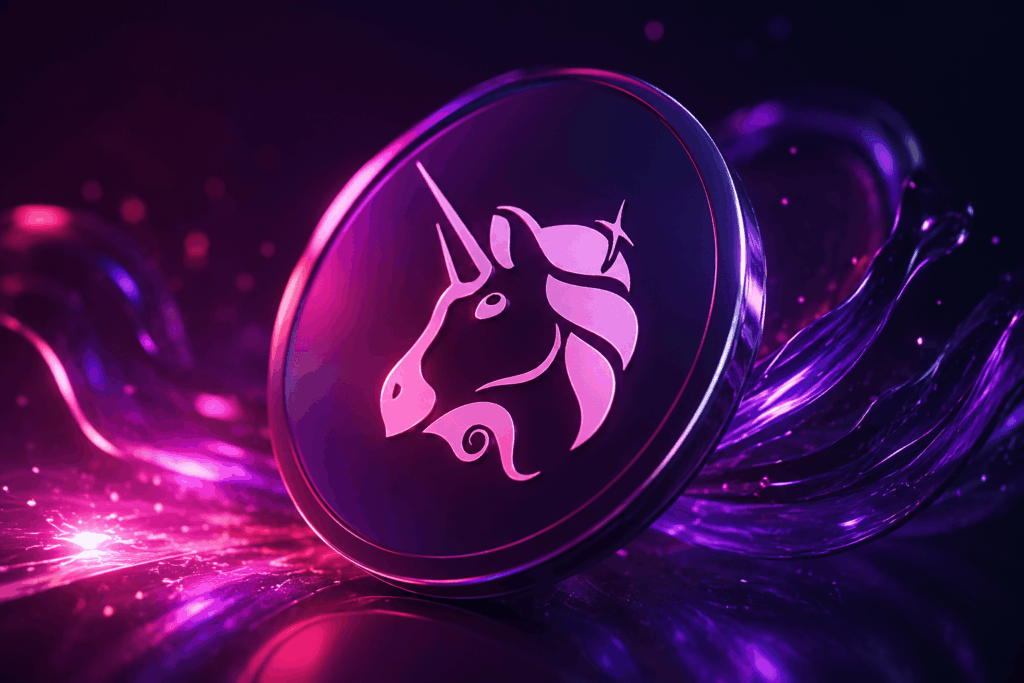
UNI Token – The Crypto Token of the Uniswap Platform
UNI is the official name of the cryptocurrency (token) of the Uniswap platform.
The UNI token has two main roles:
- Voting on the platform’s future – UNI token holders vote on protocol changes, new features, and the allocation of funds from the treasury. This is a governance token – a token for managing the platform.
- Speculative value – because Uniswap is one of the largest DeFi platforms in the world, UNI is attractive to investors betting on the growth of decentralized finance (DeFi).
UNI can be purchased directly on Uniswap or on major centralized exchanges.
DeFi – The World Where Uniswap Lives
Uniswap is part of a larger ecosystem called DeFi – Decentralized Finance.
DeFi consists of financial services (lending, borrowing, saving, insurance) without banks, without intermediaries, and without permission. Everything runs automatically through smart contracts on the blockchain.
This isn’t the future. It’s happening now, and according to analytics platforms, billions of dollars’ worth of value are locked in DeFi protocols.
Uniswap is the “entry point” into DeFi for most beginners. Once you understand how Uniswap works, you understand the logic of the entire DeFi world.
If you want an in-depth understanding of DeFi and cryptocurrencies, from the basics to earning, download my crypto e-book for free, which has already been read by thousands of Slovenes.

Pros and Cons of Uniswap for Earning
Pros ✅
Complete control over your money. Because you are the only one with access to your MetaMask wallet, no one can freeze your account or block your funds.
Access to thousands of cryptocurrencies. On Uniswap you’ll find projects that aren’t even on Binance yet. Getting into a good project early is one way to earn above-average returns in the crypto world.
Passive income through liquidity. Once you provide liquidity, you earn fees 24 hours a day, 7 days a week, without any work.
No KYC. KYC (Know Your Customer) is an identity verification process required by centralized exchanges. Uniswap doesn’t have it. You connect your wallet and start trading right away.
Transparency. All transactions are publicly visible on the Ethereum blockchain. There are no hidden dealings behind the scenes.
Cons ⚠️
Gas fees. Every transaction on the Ethereum network costs money (gas). During periods of high network congestion, costs can be higher. This should be taken into account with smaller amounts.
Complexity of V3. Uniswap V3 with concentrated liquidity requires active management. If the price moves outside your chosen range, you don’t earn fees.
Impermanent loss. As mentioned – this risk is real and needs to be understood before investing.
No customer support. Because Uniswap is decentralized, there is no call center. If you make a mistake (for example, sending money to the wrong address), there’s no going back.
Scam projects (scam tokens). Because anyone can create a token and add it to Uniswap, there are plenty of scams among new projects. Always verify the token’s official address (contract address) before you buy.
How to Protect Yourself from Scams on Uniswap
Scams exist in the crypto world. That’s a fact. But with a little knowledge, you can easily avoid them.
1. Rug pull (literally “pulling the rug out”) is a scam in which a project’s creators sell all of their coins at once and run off with the money once the price has gone up. Protection: don’t invest in projects where a small group holds most of the coins (token supply).
2. Honeypot (a honey trap) is a token that you can buy but can’t sell back. Protection: before buying, check the token on Token Sniffer or DEX Screener.
3. Phishing refers to fake websites that look like Uniswap but steal access to your wallet. Protection: always type app.uniswap.org in manually. Never click on search engine ads.
4. Never share your seed phrase. No legitimate platform will ever ask you for your 12 words.
Uniswap and the Ethereum Network: What You Need to Know
Uniswap runs on the Ethereum network – the second-largest blockchain network in the world, right after Bitcoin.
Ethereum is a special network because it supports smart contracts (smart contracts). A smart contract is a program that executes automatically when certain conditions are met. This is the foundation of everything Uniswap does.
In addition to the original Ethereum network, Uniswap also runs on Layer 2 solutions (extensions of the Ethereum network), such as:
- Arbitrum – faster and cheaper transfers with lower gas fees
- Optimism – similar to Arbitrum, with slightly different technology
- Polygon – a popular solution with very low transaction costs
- Base – Coinbase’s Layer 2 network
My recommendation: If you’re a beginner with a smaller amount of capital (under €1,000), start on Arbitrum or Polygon, where gas fees are significantly lower. That reduces your costs and increases your actual return.
A Practical Example of Earning with Uniswap
Let me show you a concrete example of what earning on Uniswap looks like in practice.
Let’s say that:
- You have €500 worth of cryptocurrency (€250 in ETH + €250 in USDC).
- You deposit both into the ETH/USDC pool on Uniswap V3 on Arbitrum.
- You choose a moderate price range (e.g., ETH between $2,500 and $4,000).
- The pool’s APR (annual percentage rate) is 20% (a realistic value for active pairs).
Monthly earnings from fees: €500 × 20% / 12 = ~€8.33 per month.
It’s not revolutionary at €500, but:
- You earn 24/7 without working.
- With more capital (e.g., €10,000), that’s €167 per month or €2,000 per year.
- If you also get into the right project early (swap), the returns are limitless.
Earning with cryptocurrencies is a game of combining strategies and growing capital over time. Start small, learn, grow.
Uniswap Compared to Other DEX Platforms
There are several decentralized exchanges on the market. Uniswap is most often compared with:
SushiSwap – A fork of Uniswap (meaning it was created as a copy of Uniswap‘s code with added features). It offers SUSHI rewards for LPs, but its volume and trust are lower.
Curve Finance – Specialized in swapping stable coins (stablecoins). Excellent low impermanent loss, but limited to stable pairs.
PancakeSwap – Runs on the BSC (Binance Smart Chain) network. Lower gas fees, but less decentralized.
Why Uniswap? Uniswap has by far the largest trading volume among DEX platforms, which means greater liquidity and better swap prices. For beginners, this is crucial.
Frequently Asked Questions About Uniswap (FAQ)
Is Uniswap safe? Uniswap as a protocol has been audited (audited) multiple times by security experts. Uniswap‘s smart contracts are reliable. The risk comes from the individual tokens you buy and from the security of your personal wallet.
How much money do I need to get started? Technically, there is no minimum. In practice, I recommend at least €100–200, because otherwise the gas fee would be disproportionately high relative to your deposit. On Layer 2 networks (Arbitrum, Polygon), it’s reasonable to start with as little as €50.
How does Uniswap differ from Binance? Binance is a centralized exchange (a company that holds your money). Uniswap is a decentralized protocol (you always stay in control of your money). On Binance you get better support and security for beginners, but less freedom. On Uniswap you have complete freedom, but more personal responsibility.
What is TVL? TVL (Total Value Locked) is the sum of all cryptocurrencies deposited in a protocol. A higher TVL means a more trustworthy and active protocol. Uniswap consistently has one of the highest TVLs among DeFi protocols.
Why Uniswap Is Not Just a Tool – It’s Your Gateway to the World of DeFi
When you learn Uniswap, you’re not learning just one platform. You’re learning the logic of decentralized finance, which will reshape how the world handles money in the coming years.
Every day you put off getting started is a day when others are collecting fees, getting into new projects, and building crypto wealth.
I started with cryptocurrencies without any special knowledge. Through experimenting, learning, and persistence, I built a system that now brings me passive income. And that’s exactly what I want to share with you.
If you’re serious about earning with cryptocurrencies and want a systematic approach from the very beginning to your first earnings, download my crypto e-book for free now. In it you’ll find everything you need to get started.
Summary: What You Learned About Uniswap
Today we’ve gone together from “what is Uniswap anyway” to concrete earning strategies. Here’s a quick summary of the key points:
- Uniswap is a decentralized exchange (DEX) – you trade directly from your wallet, with no intermediary.
- Earn as an LP – by providing liquidity to pools and collecting fees.
- Swap strategy – buying promising projects early on Uniswap before they launch on larger exchanges.
- Yield farming – an advanced strategy for maximizing passive income.
- MetaMask is your gateway – the free Web3 wallet you need.
- Layer 2 networks (Arbitrum, Polygon) – a solution to high gas fees, ideal for beginners.
- Security comes first – protect your seed phrase, verify tokens, and avoid phishing.
Uniswap isn’t overly complicated. It just takes a little time and a willingness to learn. Everything else comes with experience.
Start today. Your future self will thank you.
For all the basics you need before taking your first step, download my crypto e-book for free and start earning with cryptocurrencies the right way.