
How do some people find cryptocurrencies before they become well known and profit from them, while others only buy once the opportunity has already passed? The answer lies in a single tool that professional investors open every day, and that beginners often don’t even know exists. That tool is Dexscreener.
In this article, I’ll explain why Dexscreener is one of the most important tools for earning with cryptocurrencies, how to use it, and how you can take your first steps today – even if you’ve known practically nothing about crypto until now.
Here we’ll focus mainly on how to turn Dexscreener into a tool for real profit, which strategies to use, and which mistakes you need to avoid.
What exactly is Dexscreener?
Dexscreener is a free website that shows in real time what’s happening on decentralized exchanges around the world. It isn’t an exchange itself – it’s a kind of “control tower” that collects data from thousands of markets at once and displays it all in one place.
To make everything perfectly clear, let’s explain two terms you’ll come across in this world all the time:
- CEX (centralized exchange): These are exchanges like Binance, Kraken… Behind them stands a company that controls what can be bought and sold.
- DEX (decentralized exchange): A platform with no owner, director, or office. Everything runs automatically through smart contracts (program code that automatically carries out a coin swap once you meet the conditions). Since nobody checks what is allowed onto the market here, brand-new crypto projects appear on DEXs first – and with them, the biggest early opportunities.
Dexscreener lets you follow all of this live, without registration and for free. That’s why it’s one of the first tools you need to know how to use if you’re serious about earning with cryptocurrencies.
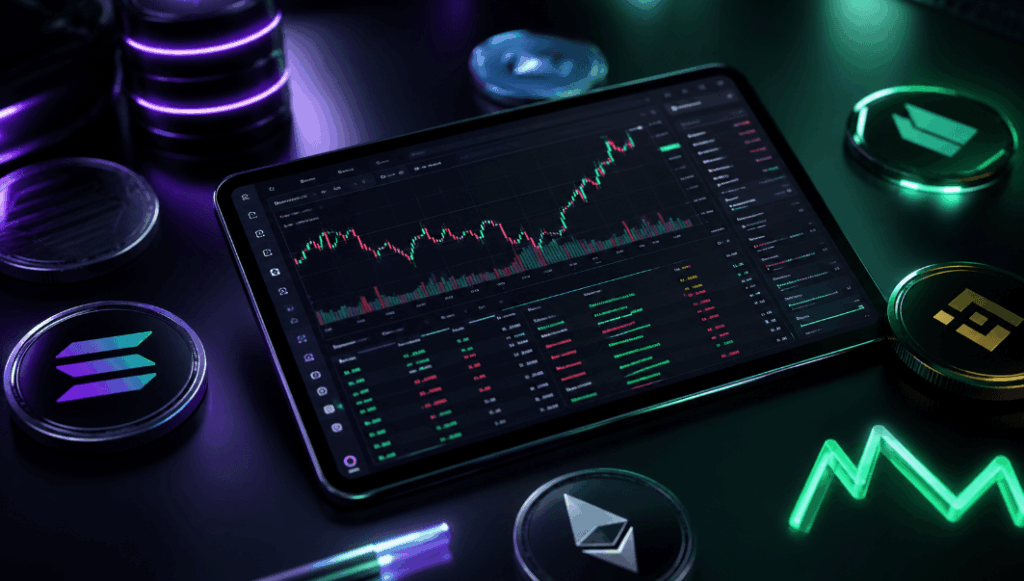
Why Dexscreener matters for your earnings
Most beginners in Slovenia know cryptocurrencies only through the big exchanges, where you buy established coins like Bitcoin. The problem is that by the time something becomes “well known,” the biggest opportunities for growth have often already passed.
Dexscreener works differently. It shows you coins the moment they’re born – and precisely those who know how to read this data have the chance to get in first. Of course, this doesn’t mean every new coin is a good opportunity – quite the opposite, most of them aren’t. That’s why, further on, I also talk about safety, not just opportunities.
Crypto glossary – terms you need to know before you start
First, let me explain the basic terms you’ll run into on Dexscreener. Once you understand them, the whole interface will suddenly make a lot more sense.
- Blockchain: A digital “highway” on which transactions travel. Every cryptocurrency lives on one or more such chains (for example Solana, Ethereum, Base).
- Liquidity: The money that is “stored” in a pool so that a coin can be bought and sold at all. Low liquidity means you can lose money simply because you can’t sell at a fair price.
- Market Cap (market capitalization): The total value of all coins in a project. It tells you how “big” the project is at the moment.
- FDV (Fully Diluted Valuation): The value of a project if absolutely all the coins that will ever be created were in circulation. It helps you judge whether the price is realistic or inflated.
- Contract Address: A unique code that specifies exactly which coin is meant. You should NEVER search for a cryptocurrency by name, because there are plenty of counterfeit coins with the same name – always use this code.
- Swap: A direct exchange of one cryptocurrency for another, with no intermediary.
- Slippage: The difference between the price you see when buying or selling and the price at which the trade is actually executed. It’s greater especially with less liquid coins and during rapid price changes.
- Rug Pull: A scam in which the project’s creator drains all the money from the liquidity pool and disappears. One of the main reasons why security analysis is a mandatory step.
- TVL (Total Value Locked): The total value of assets “locked” in a project or protocol. A higher TVL often (not always) means greater investor confidence.
Remember these terms, because they’ll come up in every following step of this article.

How to approach earning with Dexscreener
Here I’ll explain a practical approach – not theory, but the actual steps we use when looking for opportunities.
Step 1: Choosing a network
On Dexscreener, you first choose the network (blockchain) where you’ll look for opportunities. For beginners, I recommend the Solana network, because the fees (so-called “gas fees” – the cost of executing a transaction on the chain) are almost negligible, which means you can start with a smaller amount without fees eating up all your money.
Step 2: Reviewing the “New Pairs” and “Trending” sections
- New Pairs: This shows brand-new coins that have just appeared on the market.
- Trending: Here you see what everyone is talking about right now and where the money is flowing.
Combining the two gives you a bigger picture – New Pairs for early opportunities, Trending to confirm that something is really happening.
Step 3: Setting up filters
Without filters, Dexscreener is just a long list of random projects, most of which are useless or dangerous.
- Minimum liquidity
- Minimum 24-hour volume (trading volume)
- Pair age (avoid brand-new projects that are only a few minutes old)
- A market cap range that matches my risk tolerance
Filters are the step that separates random “gambling” from thoughtfully searching for opportunities.
Step 4: Reading the chart
Price is shown on the chart with so-called candlesticks – green means growth, red means decline. In addition, keep an eye on:
- Support: A price level where people often start buying.
- Resistance: A level where people often start selling.
You don’t have to become a technical analyst – it’s enough to understand the basic rhythm of the chart before deciding to get in.
Three strategies for making money
Strategy 1: Following “Smart Money”
Under each coin on Dexscreener you can open the tab with the biggest traders (Top Traders). There, you look for a wallet that turned a small investment into a large profit. You make a note of that wallet and follow it from then on. When that wallet buys something new, it’s often an early signal that something is happening – it’s an “insider’s view” without actually having any inside information.
Strategy 2: Recognizing accumulation
Accumulation means the coin’s price is staying flat while volume is high and mostly green. This is often a sign that someone is quietly buying before the price starts to rise. The opposite phenomenon is distribution – the price is at the top, volume is high, but the candles are red, which is often a signal to exit, not to enter.
Strategy 3: Combining liquidity and market cap
We never look at price alone. We always compare the ratio between market cap and liquidity. If a coin is worth a million euros on paper but has only a few thousand euros in liquidity, it means you probably won’t be able to sell your share without a big loss. This ratio is one of the most important, yet most overlooked, data points on all of Dexscreener.
I also cover more strategies in my free e-book, where I tie the steps together into a complete system – download the free e-book on making money with cryptocurrencies here.
Finding signals on social media
Dexscreener is not an isolated island – it’s also connected to social media, which helps confirm whether a real community stands behind a price increase or whether it’s just artificial hype.
- Searching on X (Twitter): We check whether real, recognizable people from the crypto world are talking about the project, or whether it’s just a few random accounts posting the same message.
- Activity on Telegram: We dive into the project’s group. Are the developers actually answering questions? Is the community growing organically, day by day, or did the member count jump overnight, which is often a sign of purchased members?
Many people skip this step, but it’s precisely the combination of chart data and the real vibe in the community that often tells you far more than price alone would.
Recognizing artificial volume (Fake Volume)
One of the things you need to know how to spot is artificially generated volume. Some project creators use so-called bots (automated programs) that generate seemingly high trading volume to make the project look more popular than it really is.
A sign to watch for: if all the transactions are nearly identical in size (for example, always the same rounded amount), it’s most likely a bot, not real people. Real, organic buyers trade with varied, random amounts. This small detail can protect you from a project that looks more promising than it really is.
A new opportunity: the Base network
Besides Solana, a growing share of trading volume is also happening on the Base network, which was developed and is backed by Coinbase, one of the largest and most regulated crypto exchanges in the world. Thanks to strong backing and a fast-growing ecosystem, Base is attracting more and more developers and new projects. Still, caution is necessary on this network too, since scams and risky projects do appear. On Dexscreener you can easily switch between networks and compare where the most action is happening at any given moment.
Safety first: how to spot a scam
Earning with crypto is real, but only if you know how to avoid scams. On Dexscreener, always check the following:
- Locked liquidity (Liquidity Lock): If the liquidity pool is locked or permanently “burned,” the project’s creator can’t simply take the money and disappear.
- Honeypot trap: If you see only green buys and no red sells on the chart, it means the coin can’t actually be sold – it’s a trap.
- Holder concentration (Holders): If the top ten wallets hold more than a fifth of all coins, the risk is much higher, because these large holders can “flood” the market in an instant and push the price down.
- Renounced Ownership: This means the developer has given up control over the project’s code, which further reduces the risk of manipulation.
Each of these steps takes less than a minute, yet they can save you a huge amount of money. Never skip the safety check, no matter how promising a project looks at first glance. I also explain the entire safety process I use for every project, step by step, in my free e-book on earning with crypto, so you’ll always have it at hand.
Psychology: the biggest enemy of your earnings
Technical knowledge is only half the story. The other half is discipline. An investor’s biggest enemy is FOMO – the fear of missing out, which pushes you to buy impulsively, without any analysis, just because you see the price rising fast.
Common beginner mistakes I see in practice
- Buying by name instead of by contract address: Because of counterfeit coins with the same name, this is one of the costliest mistakes you can make.
- Skipping the safety check: Because they’re “in a hurry,” many skip checking liquidity and holders – and that’s the most common reason for losing money.
- Investing money they can’t afford to lose: Crypto is an opportunity, not a guarantee. Only ever invest as much as you can afford to lose.
- No exit plan: Without a rule set in advance (for example, when to sell half of your position), decisions are made emotionally, not rationally.
If you want to understand the whole process – from choosing a wallet to your first trade – without these mistakes, I also show you everything step by step in my free e-book
Short-term or long-term approach – what to choose as a beginner
Before you make your first investment, it makes sense to decide which approach suits you better, since you can use Dexscreener either way.
- Short-term approach: Looking for fresh projects, getting in and out quickly once the price hits a set target. This approach requires more time, attention and discipline, since decisions are made fast.
- Long-term approach: Looking for projects with healthy fundamentals (locked liquidity, distributed holders, an active community, growing TVL), where you let your investment grow over a longer period, without constantly watching the chart.
I always recommend that beginners first learn the basics with smaller amounts before deciding which approach suits them better. There is no wrong answer – what matters is that you know what you’re doing and that you stick to your approach consistently.
A practical action plan for today
- Open Dexscreener and select the Solana network.
- Set basic filters for liquidity, volume and pair age.
- Find three projects that match the filters.
- For each project, check the liquidity lock, the holders and the chart.
- Only then, if everything checks out, consider a small, well-thought-out investment.
Frequently asked questions about Dexscreener
Is Dexscreener safe to use? Yes. Dexscreener is merely an analytics tool for viewing data, not an exchange where you would store your money directly. The risk is always tied to the projects you choose, not the tool itself.
How much money do I need to get started? On the Solana network you can start with a small amount, since fees are negligible. More important than the amount is that you first understand how to safely analyze a project.
Why is the contract address (Contract Address) so important? Because it prevents you from accidentally buying a counterfeit coin with the same name as the real project.
Can I swap coins directly on Dexscreener? Yes, with connected wallets this is possible, which simplifies the whole process considerably.
How often is the data on Dexscreener refreshed? The data is refreshed practically in real time, straight from the blockchain, so you always see the current state of the market.
Conclusion
Dexscreener is not a magic solution that guarantees you profit overnight – but it is a tool that, if you know how to use it properly, gives you insight into a market that most people don’t even see. The difference between those who make money with crypto and those who merely watch from the sidelines comes down to knowledge, discipline, and consistently following the security steps I described in this article.
If you want me to explain the entire system – from the basics to concrete strategies – in even more depth and all in one place, download my free e-book on making money with cryptocurrencies. In it, you’ll find everything you need to take your first well-considered step into the world of crypto.