We’re all looking for ways to create extra income that doesn’t eat up our entire day and gives us more freedom. Of all the options the internet offers, Amazon FBA stands out as one of the most proven methods, and it’s the one I recommend to anyone who wants a serious online business. Forget complicated systems that require programming or your own warehouses. Amazon FBA lets you use the infrastructure of the world’s largest retailer for your own profit.
If you’re a complete beginner, all of this may seem intimidating. But the system is actually simple once we break it down on a practical level. In this article, we’ll look at exactly that – how to get started, how to find a product, and how to make sure the money flows into your account.
For those of you who want to see the entire process live 👉 sign up for my free online webinar
What Is Amazon FBA and How Does It Work in Reality?
First, we need to understand the acronym. FBA stands for Fulfillment by Amazon – which means that Amazon takes care of storage, packing, and shipping for you. Put into practice: you own the products, and Amazon is your warehouse worker, packer, mail carrier, and customer support team. This business model is revolutionary because it allows an individual to do business globally from their own armchair at home.
The practical process looks like this:
You find a product that sells well. You order it from a manufacturer and ship it directly to an Amazon warehouse. When a customer clicks the “Buy” button on the website, Amazon takes the product off the shelf, packs it, and sends it to the customer’s home. You get paid for it, and Amazon takes a share of the market price for its services.
Your main task is managing inventory and sales from your computer, while the physical part of the work is handled by technology and the team in Amazon’s centers. The advantage of this system is that you can sell in markets such as Germany, the USA, or Canada without ever leaving Slovenia.
But this raises a question I hear again and again: “Žan, okay, it sounds good – but where do I even start?” So let’s keep going.
Helium 10: The Brain of Your Amazon Business
If you want to win on Amazon, you can’t guess. You need data. This is where Helium 10 comes in – a set of tools that gives you a look behind the scenes at Amazon. Without this tool, searching for a product would be like playing the lottery.
Helium 10 is a paid tool (though it also has a free version to get you started) that shows you in real time what’s selling on Amazon, how much of it is selling, and who is selling it. This is information that big companies once paid thousands of euros for in market research. Today, you get it for the price of a monthly subscription.
Finding a Product with the Black Box Feature
Helium 10 has a feature called Black Box, where you set filters and tell the system: “Show me products with monthly revenue between €5,000 and €15,000, fewer than 100 reviews, and that sell in the kitchen category.” Within seconds, you get a list of products that could be profitable. This is the fastest path to answering the question of how to make money with Amazon FBA.
Keyword Research with Cerebro
When you find an interesting product from a competitor, you want to know which words customers use to find it. The Cerebro feature (Latin for “brain”) lets you enter a competitor’s ASIN (Amazon Standard Identification Number – the unique identification number of every product on Amazon) and see all the keywords for which that product appears in search results. You then use this knowledge when writing your own title and description to outrank the competition right away.
Tracking Sales and Profits
Helium 10 doesn’t just help you get started, but also with the day-to-day running of your business. Through its dashboard, you can see your net profits, ad costs, and signals for when to order new inventory in real time, so you don’t run out of products in the middle of selling – which would cost you a huge amount of money and your Amazon ranking.
Finding a Winning Product: The Foundation of Every Amazon FBA Income
Finding a product is where most beginners make their biggest mistake. Don’t choose something just because you like it. Choose what people are already buying and what the numbers in Helium 10 confirm.
What Is Demand (Search Volume)?
Search Volume means how many people type a particular word or phrase into Amazon’s search engine each month. Helium 10 tells you the exact number – for example, 12,450 searches per month for the term “bamboo cutting board.” Without demand, there are no sales. Look for products with at least 3,000 to 5,000 searches per month.
What Is Competition and Why Does It Matter?
High demand is great, but if 10,000 strong sellers are already selling the same product, entering is very risky. As a beginner, you’re looking for niches where the sellers on the first page don’t have too many Reviews (customer ratings). Reviews are the ratings customers leave after a purchase – and they are the key currency of trust on Amazon. Look for niches where the top sellers have fewer than 200 reviews. This is a sign that the market isn’t saturated and that you have room to enter.
Product Profitability Analysis
Before you decide on any product, you need to do a precise calculation. The formula is simple:
Selling price − (purchase cost + shipping cost + Amazon fees + advertising + other expenses) = your net profit
Amazon fees depend on the category, but for most categories they range from 8% to 15% of the selling price. On top of that, you also pay the FBA fee – the storage and shipping cost that Amazon charges based on the size and weight of your package. If this calculation doesn’t leave you with at least 20% profit, the product isn’t worth your time and capital. No matter how much you like it.
Finding a Supplier: How Do You Get Your Own Product?
Once you know what you’re going to sell, you need someone to make it for you. The biggest platform for this is Alibaba (alibaba.com). It’s a website where you can find factories from all over the world – mostly from China – that manufacture practically anything you can imagine. Alibaba is not a retail site. It’s a wholesale platform designed for entrepreneurs who order in larger quantities.
But be careful – not all suppliers on Alibaba are equally reliable. You need to be cautious when choosing a partner in order to protect your money and your brand.
What Should You Look for When Choosing a Manufacturer on Alibaba?
When searching for a supplier, never look only at the lowest price. The lowest price often means the worst quality or – in the worst case – a scam. Focus on the following:
Alibaba Trade Assurance is a free protection service that safeguards your order from payment to delivery. If the supplier doesn’t ship the products on time or the quality doesn’t match what was agreed, Alibaba refunds your money. The key rule: never pay outside the Alibaba system (e.g., via Western Union or direct bank transfers to a personal account), because then you lose all protection.
Verified Supplier is a label meaning that Alibaba or an independent company (e.g., SGS or TÜV Rheinland) has physically visited the factory and checked its premises, machinery, certificates, and past business results. A supplier with this label can’t be a “room with a computer and fake photos.” It actually exists and has the capacity to handle your order.
Verified Supplier Pro is the highest level of trust on Alibaba. These suppliers have gone through even stricter inspections and have proven excellent quality, fast responsiveness, and support. If you choose a supplier with this label, you greatly reduce the risk of any problems.
Years on the platform: Always check how many years the supplier has been on Alibaba. I recommend at least 3 years or more. The longer they’ve been there, the more reliable they are.
What Does MOQ Mean?
MOQ stands for Minimum Order Quantity. It’s the smallest batch the factory will produce at all. To start, look for suppliers with a lower MOQ (e.g., 100 to 300 pieces) so you don’t risk too much capital on your first order. Once you’re convinced the product sells, you increase your orders.
Ordering Samples
Never order 500 pieces without testing a sample first. A sample is a physical piece of your future product that the supplier sends to your home – usually for a small fee that is deducted from your first order. Check the material, durability, packaging, and overall quality. If the sample isn’t what you expected, ask for corrections or switch suppliers. This step saves you from disastrous mistakes.
Want to see exactly how I write messages to suppliers and which words I use to get the best price? 👉Click here
What Does Private Label Mean?
Private Label (your own brand) is the key to real, long-term earnings on Amazon. It means you take an existing generic product and ask the factory to print your logo on it and prepare your packaging. Now you’re no longer selling someone else’s anonymous product – you’re selling your own brand.
This matters for two reasons. First, you avoid a price war. When you sell a generic product with no name of your own, any competitor can “hop onto” your listing and destroy your margin by dropping the price. With your own brand, they can’t do that. Second, you’re building an asset. An Amazon business with its own brand can be sold – and serious buyers pay between 2x and 4x annual profit. That means you’re not just building a monthly income, but long-term value.
Logistics and Shipping Products to the Amazon Warehouse
You may never actually see your products in person – and that’s okay. A well-organized Amazon FBA business works by sending products from the factory directly to an Amazon fulfillment center. Two key players come into play here: the freight forwarder and an understanding of Incoterms.
Who Is a Freight Forwarder?
A Freight Forwarder is a company that organizes the entire transport of your goods from the factory to the Amazon warehouse. They arrange sea or air freight, take care of customs documentation, and coordinate delivery. You pay one bill, and they deal with all the paperwork that would otherwise drive you out of your mind. For beginners, this is one of the most important partners in the business.
Understanding Incoterms (DDP)
Incoterms (International Commercial Terms) are international agreements that determine who is responsible for the costs and risks of shipping goods internationally. For beginners, the best option is DDP (Delivered Duty Paid). This means the supplier or freight forwarder takes care of absolutely everything – transportation, customs, import duties. Your products “appear” in the Amazon warehouse, and you have no surprises with additional costs.
Creating a Sales Page That Sells (Listing)
A listing is your product page on Amazon. It is your “digital salesperson,” which has to convince the buyer to purchase within five seconds – and without you being present. A well-made listing is the difference between making a sale and being ignored.
Title and SEO Optimization
Your product title must contain the main keywords you found in Helium 10. Amazon works like a search engine – and just like Google, it takes the keywords in the title into account when deciding who to show your product to. Use all the available characters in the title for maximum visibility. An example of a good title: “Bamboo Cutting Board with Juice Groove – Extra Large 45x30cm – Wooden Chopping Board – Eco Friendly Gift”.
Product Photos: Where the Sale Is Won or Lost
Shoppers on Amazon buy with their eyes. Your photos must be professional – this is not the place to cut corners. The first image (Main Image) must be on a pure white background; that is an Amazon requirement. The remaining images are lifestyle images – photos of the product in real-life situations, in the hands of a real person, in a real setting. In addition, infographic images are very effective today, explaining the key benefits of your product with text and icons directly on the photo. Without professional photos, you won’t earn anything, no matter how good your product is.
Bullet Points: Five Sentences That Convince
Amazon gives you space for 5 key points (bullet points) that appear at the top of the page. Here you don’t describe features – you describe benefits. The difference between a feature and a benefit: “The board is made of bamboo” is a feature. “Bamboo is a natural antibacterial material that keeps your kitchen hygienically clean” is a benefit. Buyers care about benefits, not specifications.
How to Start Selling with Advertising (PPC)
Once your product is in the Amazon warehouse and your listing is published, it’s time to advertise. Without ads at the beginning, it’s almost impossible to get your first sales – because nobody knows you and the Amazon algorithm has no reason to show you on the first pages.
What Is PPC (Pay-Per-Click)?
PPC (Pay-Per-Click) is an advertising model in which you pay only when someone actually clicks on your ad – not for every impression. Your product then appears on the first page of Amazon with a discreet “Sponsored” label. This helps you get your first customers and first reviews, which in turn raises your organic (free) ranking on Amazon.
What Is ACOS?
ACOS (Advertising Cost of Sales) is the most important metric in Amazon advertising. It means: how much you spent on advertising compared to the sales you generated. Example: if you spent €10 on ads and sold €100 worth of products, your ACOS is 10%. The goal is to have the lowest ACOS possible – under 20% is an excellent result for most categories. At the beginning, your ACOS will be higher because the algorithm is still getting to know your product. Over time, you lower it by optimizing your keywords.
For those who want to see what budget makes sense to start with
Money Management and Profit (Profit Margin)
As in any business, you need to have a complete overview of your numbers. Amazon FBA is no exception.
Understanding Margin
Profit Margin is the percentage of the sales price that remains as net profit after all costs. A good Amazon business has a margin between 20% and 35%. When you sell 500 or 1,000 units per month, these numbers add up very quickly. A seller who sells 800 units per month at €25 with a 25% margin earns €5,000 in net profit per month.
Reinvesting Profit: The Secret to Growth
This is a secret that successful Amazon sellers know and beginners often overlook. When you earn your first €1,000, don’t spend it. Buy more inventory for next month or add a new product to your lineup. The more products you have, the higher your total monthly earnings – and the faster you grow to the point where the business runs on its own.
Security on Amazon: How Not to Lose Your Account?
Amazon is very strict about its rules, and for good reason – it wants to protect buyers. If you want to earn safely and for the long term, you must consistently follow its guidelines.
What Are the Terms of Service (ToS)?
The Terms of Service are Amazon’s rules of the game. The biggest mistake I see beginners make is trying to cheat the algorithm – for example, by buying fake reviews or arranging “pre-agreed” purchases. Amazon’s algorithms and fraud detection team are extremely sophisticated. The penalty is usually permanent account suspension, with no possibility of appeal. It’s not worth it.
Brand Protection (Brand Registry)
Once your business grows and you register your trademark (with the appropriate intellectual property office), also enroll it in Amazon Brand Registry – Amazon’s trademark registry. This gives you legal protection against counterfeits and copies, and it also unlocks advanced tools: video ads in search results, your own “Amazon Store” page, and better analytics data.
Expanding to Other Marketplaces: Global Reach from Your Living Room
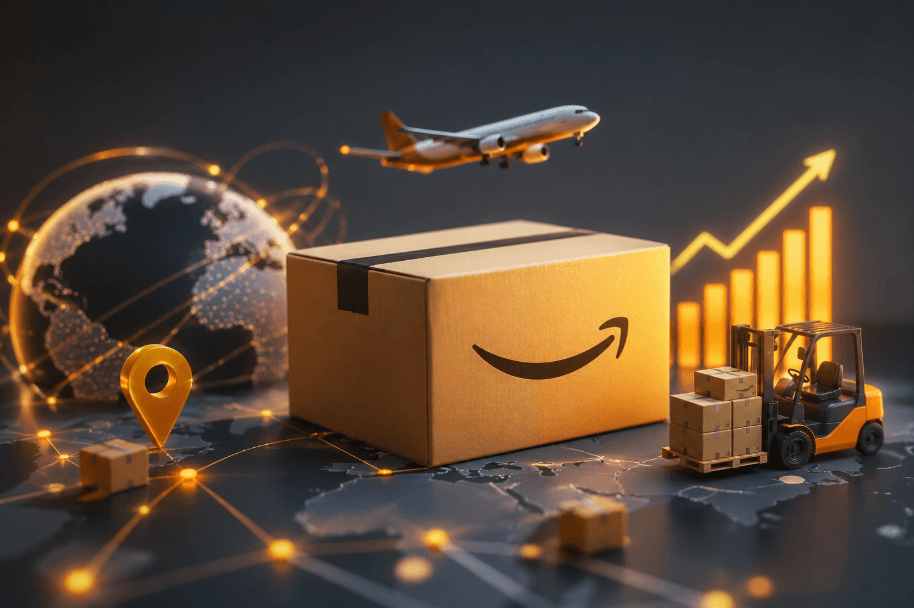
Once you’ve mastered selling on one marketplace (e.g., Amazon Germany – amazon.de), expanding to others is simple. Amazon has a Pan-European FBA system that lets you send your products to one central warehouse, and Amazon distributes them across Europe on its own. This means that with one shipment and one invoice, you can reach customers in Germany, France, Italy, Spain, and the Netherlands. Hundreds of millions of potential buyers.
The Most Common Mistakes I See Among Beginners
In all my years of working with Amazon sellers, I’ve seen the same mistakes over and over. Here are the ones that cost you the most:
Mistake 1: Choosing a product by gut feeling instead of data. The seller picks a product they personally like, without checking demand and competition in Helium 10. The result: capital frozen in inventory that doesn’t sell.
Mistake 2: Skimping on photos. Amateur images mean no sales. Photos are your sales team. Don’t cut corners here.
Mistake 3: Too small an advertising budget. Many beginners put all their capital into inventory and have nothing left for PPC ads. Without advertising at the start, you’ll be invisible on Amazon.
Mistake 4: Skipping the sample. Ordering 300 units without testing a sample is gambling. Always, always get a sample first.
Mistake 5: Giving up too soon. Amazon FBA needs time to stabilize. Algorithms need time, and reviews accumulate slowly. Sellers who give up after the first month never see the fruits of their work.
The Psychology of a Successful Seller
Earning money with Amazon FBA requires not only knowledge but also the right mindset. A supplier may be late. A customer may demand a refund. An ad may not perform right away the way you imagined. A successful seller sees these things as part of the business – not as catastrophes, but as feedback to use for improvement. Perseverance is the quality that separates those who earn from those who just “gave it a try.”
Conclusion: Your Path to Financial Freedom with Amazon FBA
Amazon FBA is one of the few opportunities today where an individual from Slovenia can compete with global sellers with a relatively small investment. The entire system is designed to help you succeed – because Amazon only makes money when you do.
Now you understand the whole picture:
- Finding a winning product with the help of Helium 10
- Finding a verified supplier on Alibaba using Trade Assurance and Verified Supplier status
- Ordering samples and negotiating the best price
- Logistics and shipping through a freight forwarder with DDP terms
- Optimizing your product page (listing) with keywords, professional photos, and persuasive bullet points
- Using PPC advertising to kick-start sales quickly
- Smartly reinvesting profits to grow your Amazon empire
The next step is action. Information without action has no value.
👉Sign up for the free webinar and start your Amazon journey today.
Frequently Asked Questions About Amazon FBA Earnings (FAQ)
Do I have to ship products to customers myself? No. That’s the main advantage of the FBA system. Amazon takes care of all the logistics, packaging, and shipping. You don’t even need physical contact with the product.
How much money do I need to get started? Realistically, it’s wise to have at least €1,000. This includes buying your first inventory, samples, shipping, professional photos, and an initial advertising budget.
What happens if a product doesn’t sell? If a product doesn’t sell, it usually means something is wrong with the listing – the images, the title, the price – or it’s simply the wrong product. In that case, if nothing else works, use discounts to clear out your inventory, recoup your investment, and put the money into a new, better-analyzed product.
Where can I see my profits? Everything is in the Seller Central interface – your dashboard on Amazon, where you can see sales, costs, and profit. Amazon automatically transfers your earnings directly to your bank account every two weeks.
Is it safe to send money to Alibaba? Yes, provided you always use Alibaba Trade Assurance. The system holds the money and pays the supplier only once you confirm that the order has been shipped and meets the standards.
What if I don’t speak English? A basic understanding of English is recommended, but today tools like ChatGPT and Google Translate let you communicate fluently with suppliers without major difficulties. For a listing on Amazon.de, you need text in German – you can easily translate it yourself or hire a translator.
Is Amazon FBA possible from Slovenia? Absolutely. I recommend a registered business (sole proprietorship or LLC) and a USD bank account that accepts international transfers if you’ll be doing business with the US. Everything else is the same as for sellers anywhere in Europe.