Whale alert: what it is and why you should track it
In this article, I’ll show you how to track large investors, which tools to use, and how to turn that knowledge into concrete decisions.
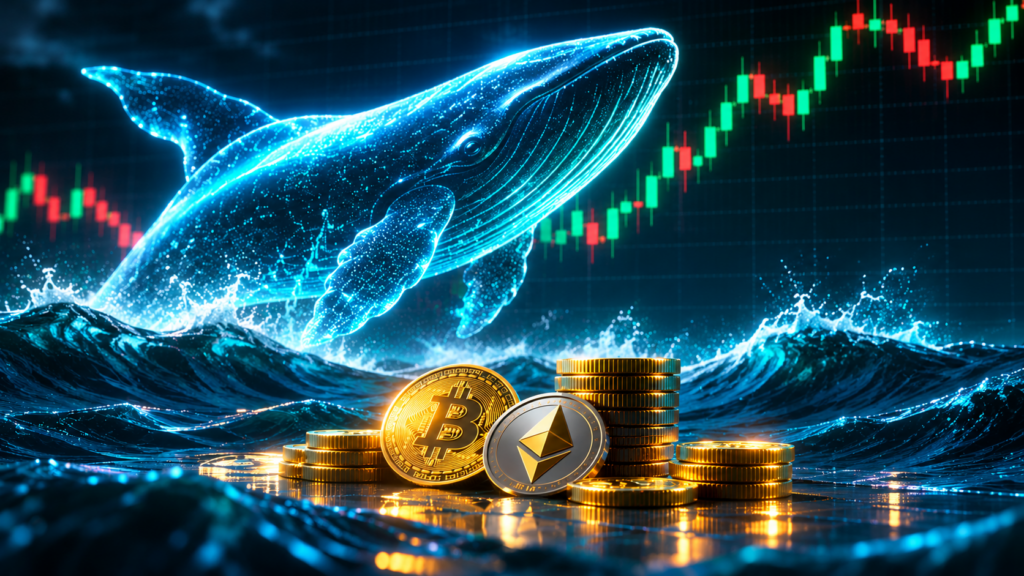
Whale alert loosely translates to “a warning about a whale.” In the crypto world, a whale isn’t an animal, but a person or company holding a huge amount of cryptocurrency. When a whale like that moves a large sum, it shows up on the blockchain. A whale alert tool detects that transaction and sends you a notification.
Let me briefly explain two more terms you’ll come across often:
- Cryptocurrency is digital money that doesn’t exist in physical form. The best known are Bitcoin (BTC) and Ethereum (ETH).
- Blockchain is a public digital ledger in which all transactions are recorded. Anyone can inspect it, which is why we can also see whale movements.
If you’re a complete beginner, I recommend that you first read my free crypto e-book. In it, I’ve gathered the basics that will help you understand this article even more easily.
Who are the whales and why do they move cryptocurrency prices
Whales are the biggest players in the crypto market. They can be early Bitcoin buyers, investment funds, exchanges, or companies. They all have one thing in common: they hold so much cryptocurrency that a single purchase or sale can move the price.
Imagine a small pond. If a frog jumps in, the water barely moves. But if a whale jumps in, it creates a wave that everyone feels. That’s exactly how the crypto market works.
When does someone become a whale?
There’s no official threshold. With Bitcoin, a wallet with at least 1,000 BTC is often considered a whale. With smaller coins, someone with just a few hundred thousand euros can be a whale. That’s why whale alert tools usually show transactions worth at least a few million dollars.
A wallet is your digital “account” where you store your cryptocurrency. Every wallet has its own address, which looks like a long string of letters and numbers.
Why whales affect the price
The price of a cryptocurrency is set on an exchange. An exchange is an online platform where people buy and sell cryptocurrency, such as Binance, Kraken, or Coinbase. When there are more buyers than sellers, the price rises. When there are more sellers, the price falls.
With its size, a whale can quickly upset this balance. If it sells 5,000 BTC at once, a huge supply suddenly appears on the market. The price therefore often drops. If it buys over several days in a row, it can create a quiet rise that most people only notice later.
An important term here is liquidity. Liquidity tells you how easily you can buy or sell a cryptocurrency without moving the price significantly. With Bitcoin, liquidity is high. With small coins, however, a single whale can cause a jump or drop of several tens of percent.

Smart money is not the same as a whale
On X, you’ll often come across the term smart money. This is what we call investors who have correctly predicted market movements many times in the past. But not every whale is smart money. Some whales are just exchanges moving their users’ funds. I’ll show you how to tell them apart below.
The best whale alert tools
The good news is that you don’t need expensive software to track large investors. Most tools have a free version that’s more than enough for a beginner.
| Tool | What I use it for | Price | For beginners |
| Whale Alert | Quick notifications about large transactions | Free, paid plans for advanced users | Yes |
| Arkham | Who’s behind a wallet | Free | Yes |
| Nansen | Smart money and in-depth analysis | Free and paid | Moderate |
| Etherscan | Checking an individual transaction | Free | Yes |
Whale Alert – the easiest way to start
Whale Alert is the best-known service for tracking large transactions. It monitors more than twenty blockchains, including Bitcoin, Ethereum, and Tron. When someone moves a large sum, the service posts a short message on X, in Telegram, and in its app.
A message looks roughly like this: “2,000 BTC transferred from unknown wallet to Binance.” From a single sentence, you already learn the amount, the value, the direction, and the destination.
My tip: turn on notifications only for coins that you own or plan to buy. That way you won’t be flooded with hundreds of messages a day.
Arkham – who’s hiding behind a wallet
Arkham links anonymous addresses to real names. It shows you whether a wallet belongs to an exchange, a fund, or a well-known investor. This is very important, since a transfer by an exchange has a completely different meaning than a transfer by a private whale.
Nansen – for those who want more
Nansen labels smart money wallets. That way you can see what successful investors are buying. I already covered this tool in more detail in one of the earlier articles on my blog.
Etherscan – a detective for every transaction
Etherscan is a blockchain explorer (block explorer). It’s a website where you enter a wallet address or a transaction ID and see all the details.
A transaction hash is the unique identifier of each transaction. It works like a tracking number at the post office: you can always use it to check where the money went.
If you want to see step by step how I open an exchange account and set up a wallet before I start tracking whales, you’ll find it all in my free e-book for beginners.
How to read whale alert signals: 4 types of movements
An alert alone doesn’t tell you much. What matters is understanding what the movement means. That’s why I look at every alert through one question: where did the money come from and where did it go?
1. From a wallet to an exchange (exchange inflow)
This is the movement I watch most closely. A whale sends cryptocurrency from a private wallet to an exchange. They usually send it to an exchange because they want to sell.
This is called an exchange inflow. A large inflow often signals selling pressure and a possible price drop. But not necessarily. A whale can also send crypto as collateral for other trading.
2. From an exchange to a wallet (exchange outflow)
Here the story is reversed. A whale buys crypto on an exchange and moves it to their private wallet. This is called an exchange outflow.
When someone withdraws coins from an exchange, they usually don’t intend to sell them any time soon. This is a sign of accumulation, meaning the slow, gradual building up of a crypto position. If I see several such movements in a row, I consider it a positive signal.
Whales often move coins to a cold wallet. This is a wallet that isn’t connected to the internet, which makes it the safest option for long-term storage.
3. Minting and movements of stablecoins
A stablecoin is a cryptocurrency whose value is pegged to the dollar. The best known are USDT and USDC, which are always worth about one dollar.
When a whale alert shows that the issuer has minted a large amount of new USDT, it means new money is entering the market. If large sums of stablecoins then travel to exchanges, whales are often preparing to buy. To me, this is one of the most useful signals.
4. Transfers between wallets
Sometimes a whale simply moves crypto from one of their wallets to another. Or an exchange transfers funds between its internal wallets. Such movements are often noise. Noise means data that seems important but doesn’t affect the price.
That’s why I always check in Arkham whether the sender and the recipient are the same organization.
My quick table for reading signals
| Movement | What it usually means | My reaction |
| Wallet → exchange | Possible sale | Caution, I check my protection |
| Exchange → wallet | Accumulation | I look for a buying opportunity |
| Stablecoins → exchange | Money ready for purchases | I watch the price closely |
| Exchange → exchange or internal transfer | Often noise | I ignore it |
4 simple strategies for making money with crypto using whale alerts
Now we come to the most important part. Below are the strategies I use myself. None of them is complicated. But remember: a whale alert is a compass, not a crystal ball. So confirm every signal with another piece of data.
Strategy 1: Buy when whales accumulate
When I see large Bitcoin or Ethereum outflows from exchanges for several days in a row while the price stays flat, I start buying gradually.
- On Whale Alert, track exchange outflows for your chosen cryptocurrency.
- If you notice at least three to five of them within a few days, open the price chart.
- If the price hasn’t risen yet, buy a small portion of the amount you’ve set aside for investing.
- Buy the rest gradually, for example once a week.
This gradual buying is called DCA (dollar cost averaging). Instead of buying everything at once, you buy in several parts. This reduces the risk of buying right at the top.
Strategy 2: Tracking stablecoins
When a large amount of USDT or USDC arrives on an exchange, I note which exchange the money went to. Then I watch which coins on that exchange start to rise.
This doesn’t mean I buy right away. It means I’m ready. When the price starts rising on higher trading volume, I enter with a smaller amount. Volume is the total value of all buys and sells over a given period.
Strategy 3: Copying smart money
With tools such as Nansen and Arkham, you can track specific wallets. Choose a few wallets that have bought well in the past. Then set up an alert for when they buy a new coin.
Keep two things in mind:
- A whale can get in with millions and easily withstand a 50 percent drop. You probably can’t.
- By the time you notice a purchase, the whale may already be in profit. So never invest more than you are prepared to lose.
Copy trading uses a similar idea, automatically copying the trades of other users. I wrote about this in my article on the Bitget exchange.
Strategy 4: Watching Smaller Coins
With smaller coins, whales have an even bigger impact. All cryptocurrencies other than Bitcoin are called altcoins. On decentralized exchanges, a single large transaction can move the price of an altcoin by tens of percent.
A decentralized exchange (DEX) is an exchange without an intermediary, where you trade directly from your own wallet. Examples are Uniswap and Jupiter. To track whales on these exchanges, I use Dexscreener, where I can see larger purchases in real time.
This strategy is riskier, so allocate only a small portion of your capital to it.
I described money allocation strategies in more detail in my free e-book on earning with cryptocurrencies.
Mistakes beginners make when tracking whales
1. Reacting to every alert. Whale Alert posts a huge number of transactions every day. Most of it is noise. If you buy or sell after every message, you will lose money and your nerves.
2. Making decisions out of fear or FOMO. FOMO (fear of missing out) is the fear that you will miss an opportunity. This feeling pushes you to buy when the price is already high. Instead, wait for the signal to be confirmed.
3. Forgetting about internal exchange transfers. Exchanges constantly move funds between their own wallets. So before making any decision, check who the sender is.
4. No exit plan. Before every purchase, write down two numbers. The first is the price at which you take profit. The second is the price at which you limit your loss (stop-loss).
5. Investing your entire savings. The crypto market is very unstable. Volatility means that the price fluctuates quickly and sharply. Invest only money that you don’t need for everyday life.
Safety First
Because whale alert channels are so popular, scammers often fake them. On Telegram, you will find fake channels promising “guaranteed signals.” Never send cryptocurrency to strangers.
Likewise, never share your recovery words (seed phrase) with anyone. These are the 12 or 24 words that unlock your wallet. Whoever has them has your money. Use only the official websites of the tools, and always check the website address before logging in.
Frequently Asked Questions About Whale Alert
Is Whale Alert free?
Yes. You can follow Whale Alert’s posts on X and Telegram for free. Paid plans are intended for advanced users who want faster data or API access. An API is an interface through which programs automatically connect to a service.
Can I reliably predict the price with Whale Alert?
No. Whale Alert shows you what is happening, not what will definitely happen. Use it as an additional signal alongside the price chart and your own strategy.
What does it mean when a lot of Bitcoin goes to an exchange?
It usually means that a whale is preparing to sell, which can cause the price to drop. But always check that it isn’t just an internal exchange transfer.
Which whale alert signal is the most useful for beginners?
In my experience, these are cryptocurrency outflows from exchanges and large inflows of stablecoins to exchanges. Both are easy to understand. The first indicates accumulation, and the second indicates preparation for purchases.
Is tracking large investors legal?
Yes. Blockchain data is public and anyone can view it. The tools simply organize it into a clearer format.
How much money do I need to get started?
You don’t need anything to track whales. To buy cryptocurrency, on most exchanges you can start with just a few tens of euros. I explained how to take your first steps in my free e-book.
Conclusion: You Can’t Beat the Whales, but You Can Swim With Them
Here is the gist in brief:
- An inflow to an exchange means a possible sale.
- An outflow from an exchange means accumulation.
- Stablecoins on an exchange mean money ready for purchases.
- Verify every signal and always have a stop-loss set.
Start simple. Follow Whale Alert on X or Telegram, pick one or two cryptocurrencies, and just observe for a month. Write down the signals and what happened to the price afterward. That’s the fastest way to develop a feel for the market.
If you want a complete plan for getting started with crypto from scratch, download my free crypto e-book. In it, I guide you step by step from opening an account to making your first investment.
See you in the next article on my blog!